TSO PRO – Trend & Momentum Unified EngineAdvanced unified engine for detecting structural trend shifts and momentum transitions in price movement. Designed for traders who need deeper resolution, dynamic behavior, and automation-ready output.
💡 Why TSO PRO Is Different
Traditional oscillators separate their functions:
• MACD → trend inflection
• RSI → momentum strength
• Stochastics → oscillation bias
Because they rely on averaged data, these tools often react slowly
or fail to reveal structural turning zones in time.
TSO PRO works differently.
It interprets structural changes inside price movement, providing a unified view of both trend behavior and momentum shifts with higher resolution, faster transition visibility, and dynamic responsiveness.
What’s Inside TSO PRO
TSO PRO expands on the Lite version with additional layers, enhanced structural interpretation, and automation-ready outputs.
🔹 Included in TSO PRO
• TSO Line (Enhanced) – refined directional feedback
• TSO Flow (Advanced) – high-resolution background structure
• TSO Pulse (Enhanced) – dynamic expansion/compression behavior
• TSO Drive – active directional pressure
• TSO Extremes – turning-zone detection
• Automation Layer – webhook-ready alerts
• Full multi-layer unified engine
🔹 Ideal for
• experienced traders
• structural behavior analysis
• automated system builders
• high-resolution oscillation mapping
TSO Lite vs TSO PRO – Feature Comparison
───────────────────────────────────────────────
TSO LITE | TSO PRO
───────────────────────────────────────────────
Core Layers ✔ 3 layers | ✔ Full multi-layer engine
TSO Drive ✘ Not included | ✔ Dynamic response
TSO Extremes ✘ Not included | ✔ Turning-zone detection
Automation ✘ Not supported | ✔ Webhook automation
Best For Beginners | Advanced traders
───────────────────────────────────────────────
🔗 How to Access TSO PRO
TSO PRO is available via subscription:
• Monthly: tradesmith6.gumroad.com
• Yearly (best value): tradesmith6.gumroad.com
All subscribers receive continuous updates, feature improvements, and priority support.
📌 Licensing
TSO PRO is a paid invite-only indicator. Redistribution, resale, or reverse-engineering attempts are prohibited.
📌 Disclaimer
This tool does not guarantee profit. All trading is at your own risk.
가격 움직임 내부의 구조적 변화(Trend + Momentum)를 고해상도로 해석하도록 설계된 통합형 엔진 기반 오실레이터입니다. 고급 트레이더, 자동매매 사용자, 구조 분석 전문가에게 최적화되어 있습니다.
💡 TSO PRO가 특별한 이유
일반적인 오실레이터는 기능이 나뉘어 있습니다:
• MACD → 추세 전환
• RSI → 모멘텀 강도
• Stochastics → 진동 편향
이들은 대부분 평균 기반 계산 방식에 의존하여
전환 구간이 늦게 나타나거나 중요한 변화를 놓칠 수 있습니다.
TSO PRO는 다른 방식으로 작동합니다.
가격의 내부 구조적 변화를 해석하여
추세 변화와 모멘텀 전환을 더 빠르고 정밀하게 보여주는 고해상도 통합 엔진 방식으로 구성되어 있습니다.
TSO PRO 구성 요소
TSO PRO는 Lite 버전보다 더 많은 레이어, 고해상도 구조 감지, 자동매매(Webhook) 대응 기능을 포함합니다.
🔹 TSO PRO 포함 기능
• TSO Line (고급형) – 강화된 방향 반응
• TSO Flow (고해상도) – 심층 구조 흐름
• TSO Pulse (강화형) – 확장/압축 리듬 변화
• TSO Drive – 적극적인 방향 압력
• TSO Extremes – 전환 구간 감지
• Automation Layer – Webhook 자동매매 지원
• 멀티 레이어 기반 통합 엔진
🔹 적합한 사용자
• 중급~고급 트레이더
• 구조 기반 분석가
• 자동매매/전략화 사용자
• 고해상도 관찰이 필요한 트레이더
TSO Lite vs TSO PRO – 기능 비교
───────────────────────────────────────────────
TSO LITE | TSO PRO
───────────────────────────────────────────────
핵심 레이어 ✔ 3 레이어 | ✔ 멀티 레이어 엔진
TSO Drive ✘ 미포함 | ✔ 동적 반응
TSO Extremes ✘ 미포함 | ✔ 전환 구간 감지
자동매매 지원 ✘ 지원 안 함 | ✔ Webhook 자동화
적합한 사용자 초보자 | 고급 트레이더
───────────────────────────────────────────────
🔗 TSO PRO 구독 안내
더 깊은 구조 분석, 고해상도 감지, 자동매매(Webhook)이 필요하다면:
• 월간 구독: tradesmith6.gumroad.com
• 연간 구독(가성비): tradesmith6.gumroad.com
구독자에게는 지속적 업데이트와 기능 강화가 제공됩니다.
📌 라이선스
TSO PRO는 유료 초대형(Invite-only) 지표입니다.
재배포, 재판매, 역설계 시도는 금지되어 있습니다.
📌 면책 조항
본 도구는 수익을 보장하지 않으며, 모든 매매 책임은 사용자에게 있습니다.
M-oscillator

Multi-Timeframe TTM Squeeze Pro with alerts and screenersBased of John Carters TTM Squeeze. Must open the settings and select wether you want to match the timeframe in your chart. This must be done in the pinescreener as well otherwise results will not be correct.
---
# **Squeeze Momentum Pro – Enhanced Screener + EMA Cross Alerts**
This custom version of the Squeeze Momentum indicator expands the standard TTM-style squeeze with screening and automated alert logic so you can quickly find high-quality setups across many tickers.
---
## **What This Script Does**
This indicator plots a three-level squeeze visual similar to TTM Squeeze:
Dot meanings in this indicator
Orange dot:
Strongest squeeze – Bollinger Bands are inside the tightest Keltner level (highest volatility compression).
Red dot:
Medium squeeze – still compressed, but not as tight as orange.
Black dot:
Weak squeeze / lowest level of volatility compression.
Price is coiling, but not as tight as the higher levels.
Green dot (“Fired”):
Squeeze has released — Bollinger Bands have expanded out of the channels and momentum is moving.
A momentum histogram is plotted to show directional pressure during the squeeze.
---
## **Major Improvements Added**
### **① Screenable Conditions for Stock Scanners**
This version includes multiple `alertcondition()` flags so the script can be used as a **Pine Screener inside TradingView**.
Currently it can screen for:
✔ Price closing above the 50-SMA
✔ Presence of an **orange (strong) squeeze dot**
✔ 6/20 EMA crossover signals inside a squeeze
These can be used inside the TradingView Screener or in watchlists to automatically highlight qualifying tickers.
---
### **② 6/20 EMA Trend Signals (Filtered by Squeeze)**
A crossover system was added:
* **Bullish Signal:** 6 EMA crosses above 20 EMA
* **Bearish Signal:** 6 EMA crosses below 20 EMA
But **these signals only trigger if the market is in a red or orange squeeze**, which helps remove noise and focus on valid setups.
---
### **③ Visual Markers Under the Histogram**
Whenever an EMA crossover occurs during a squeeze:
* A **green up-triangle** is plotted for a bullish cross
* A **red down-triangle** for a bearish cross
These markers are drawn **below the histogram**, keeping the display clean while still providing quick visual cues.
---
### **④ Fully Non-Repainting Logic**
All signals and squeeze calculations are based on standard fully-resolved `ta.*` functions, making the results stable both in backtesting and real-time.
---
## **Who This Script Helps**
This version is ideal for:
* Traders who use TradingView’s screener and want automated breakout/continuation filtering
* Traders who scan large watchlists for squeeze setups
* Users who want trend confirmation during volatility compression
---
## **How to Use It**
1. Add the script to your chart
2. Open TradingView Alerts or Screener
3. Select the conditions you want, for example:
* *“Orange Squeeze Detected”*
* *“Squeeze Fire after 3 squeeze dots*
* *“4 REd Dots in a row.”*
* *“Buy Alert”*
* *“EMA 6/20 Bullish Crossover (Squeeze Only)”*
* *“Close Above 50 SMA”*
Once active, TradingView will automatically flag symbols that meet the criteria.
---
## **Summary**
This enhanced Squeeze Momentum indicator turns the standard TTM-style visual into a **true screening and alert system** by adding:
* Multi-level squeezes
* EMA trend signals
* Screener-compatible alert conditions
* Clean visual signals
* Non-repainting logic
It helps traders quickly locate high-probability setups across any watchlist or market.

Turtle System 1 Long & Short (Donchian + N-Stop) + MTF Table V6 Turtle Trading Long & Short (System 1 – 20/10 Donchian + True 2N Trailing Stop) + Multi-Timeframe Dashboard – Pine Script v6This indicator is a 100 % faithful implementation of the famous original Turtle Trading System 1 (Richard Dennis & William Eckhardt) with the following genuine rules:Entry: 20-period Donchian Channel breakout (using the high/low of the previous completed bars only → )
Exit: Classic 10-period Donchian opposite breakout OR hit of the volatility-based stop
Risk Management: True 2N trailing stop (N = 20-period ATR). The stop is pulled tighter on every new favorable extreme (real Turtle trailing – not fixed!)
Fully dynamic position tracking (Long / Short / Flat) on the chart’s timeframe
Visual signals: green/red triangles for entries, diamonds for exits, trailing stop line, entry labels with current N and stop price
Unique Feature – Multi-Timeframe (MTF) Status Table
A clean table in the top-right corner instantly shows the current Turtle position status on five higher timeframes simultaneously:Turtle MTF
1H
4H
8H
1D
1W
Status
LONG / SHORT / FLAT (color-coded)
This allows you to see at a glance whether higher timeframes are already in a Turtle trend – perfect for trend confirmation, filtering, or multi-timeframe trading.Key Visual ElementsLime upper Donchian line (20-period high)
Red lower Donchian line (10-period low)
Gray channel fill
Fuchsia trailing 2N stop line (moves only in favorable direction)
Entry labels showing current N-value and exact stop price
Arrows and diamonds for entries/exits
Alerts
Two ready-to-use alert conditions:“Turtle Long Entry”
“Turtle Short Entry”
Works on any market and any chart timeframe (stocks, forex, futures, crypto).
Completely written and tested in Pine Script version 6.A true, clean, no-nonsense Turtle System 1 with real trailing volatility stops and a powerful higher-timeframe dashboard – exactly how the original Turtles traded (only better visualized)! Enjoy the trends!

Weighted RSI DivergenceWeighted RSI Divergence
A powerful divergence engine that grades every RSI divergence by strength, context, and confluence — helping you filter noise and focus only on the highest-probability reversal setups.
This script combines RSI divergences with five confirmation layers to produce confidence-weighted signals, clearer trade decisions, and alert-ready setups for both bullish and bearish reversals.
What This Indicator Detects
Bullish Divergence → Price makes a lower low while RSI makes a higher low
Bearish Divergence → Price makes a higher high while RSI makes a lower high
Confirmation Factors (Each Adds +1 to the Score)
Volume Spike: Above-average volume on the divergence bar
Trend Alignment: Divergence occurs in harmony with higher-timeframe trend dynamics
Key Level Proximity: Price tests significant support or resistance
Momentum Extremes: RSI reaches oversold/overbought thresholds
Candle Reversal Pattern: Engulfing, pin bar, or similar reversal structure
Confidence Scoring
1–2 → Low Confidence (gray)
3 → Medium Confidence (yellow)
4–5 → High Confidence (green/red)
Higher scores = higher-probability setups.
Visual Components
RSI plot with dynamic gradient coloring
Divergence lines mapped to RSI pivots
Signal labels showing confidence + factors
Background highlighting for high-confidence events
Real-time confidence meter for active bar conditions
Optional data table for factor-by-factor breakdown
Alerts Included
High-confidence bullish & bearish divergences
Medium-confidence signals
Any divergence meeting your minimum threshold
Best Practices
Prioritize setups with 4 or 5 confirmations
Use higher timeframes (4H, 1D, 1W) for more reliable signals
Combine with market structure and price action (S/R, HTF trend, liquidity zones)
Counter-trend divergences require stronger scores to validate
Final Notes
This script focuses on clarity, risk reduction, and selective trade timing. The confidence system helps distinguish weak divergences from high-probability reversal conditions — giving traders a structured, repeatable edge.

VZO Enhanced価格の上昇バーと下降バーごとに出来高を分離し、それぞれをEMAで平滑化して算出した Volume Zone Oscillator(VZO)の改良版です。
デフォルトでは20期間のEMAを使用し、トレンド方向に対する出来高の偏りをパーセンテージで表示します。
オーバーボート/オーバーソールドの水準(初期値 +60 / -60)を背景色でハイライトし、短期トレードでの反転ポイントや勢いの弱まりを視覚的に捉えやすくしています。
This script is a modified version of the Volume Zone Oscillator (VZO) tailored for short–term trading.
It separates volume into positive volume (when the close is higher than the previous close) and negative volume (when the close is lower than the previous close), then applies EMA to:
* positive volume
* negative volume
* total volume
The oscillator is calculated as the percentage difference between positive and negative volume relative to total volume.
By default it uses a length of 20 (EMA Length = 20) and highlights overbought / oversold zones (initially +60 / -60) with background colors, making it easy to see:
* trend strength based on volume
* shifts in volume pressure
* potential reversals and divergences between price and volume.

Green Pill 🟢 Red Pill 🔴Green Pill 🟢 Red Pill 🔴 Indicator
Overview
The Green Pill 🟢 Red Pill 🔴 is a momentum-based trend indicator designed to simplify market entry and exit signals. Built upon the classic Moving Average Convergence Divergence (MACD) logic, this oscillator transforms raw data into clear, actionable visual cues—"Pills"—that help traders identify shifts in market momentum instantly.
Unlike standard MACD tools that require you to interpret line crossovers manually, this indicator automatically detects these crossovers relative to a customizable threshold and projects clear Long (Green Pill) and Short (Red Pill) labels directly onto the indicator pane.
How It Works
This script calculates the momentum of the asset by comparing two Exponential Moving Averages (EMAs):
MACD Line: Derived from the difference between the Fast Length and Slow Length EMAs.
Signal Line: An EMA of the MACD Line itself.
Histogram: The difference between the MACD Line and the Signal Line.
The "Pill" Logic
Signals are generated based on the Histogram's interaction with a user-defined Signal Threshold:
🟢 Green Pill (Long Signal): Triggered when the Histogram crosses above the threshold. This suggests bullish momentum is building.
🔴 Red Pill (Short Signal): Triggered when the Histogram crosses below the threshold. This suggests bearish momentum is taking over.
Features
Visual Clarity: Bright, distinct labels (Green/Red Pills) make it easy to spot trend reversals at a glance.
Customizable Sensitivity: The Signal Threshold input allows you to filter out "noise" in ranging markets. Increasing this value requires stronger momentum to trigger a signal.
Full MACD Visualization: Includes the standard Histogram, MACD Line, and Signal Line for deeper technical analysis.
Alert Ready: Built-in alert conditions allow you to set up TradingView alerts for both Green and Red Pill signals, ensuring you never miss a move.
Settings
Fast Length (Default: 12): The period for the fast EMA.
Slow Length (Default: 26): The period for the slow EMA.
Signal Length (Default: 9): The smoothing period for the signal line.
Signal Threshold (Default: 0.0): The value the histogram must cross to trigger a signal. Set higher to filter out weak signals or keep at 0.0 for standard zero-line crossovers.
How to Use
Add the indicator to your chart.
Look for a Green Pill 🟢 label as a potential buy/long entry signal.
Look for a Red Pill 🔴 label as a potential sell/short entry signal.
Use the colored Histogram bars to gauge the strength of the current trend.

Dr Alexander Elder - Triple Screen in One Opportunity WindowElder Triple Screen - Screen 3 (Opportunity Windows)
Overview
This indicator is the visual overlay component of Dr. Alexander Elder's renowned Triple Screen Trading System. It identifies and highlights precise trading opportunities directly on your price chart by combining signals from Screen 1 (trend identification) and Screen 2 (pullback detection).
What It Does
Screen 3 creates colored opportunity windows on your chart that show exactly when market conditions align for potential trades:
🟢 GREEN WINDOWS = LONG opportunities (uptrend with pullback)
🔴 RED WINDOWS = SHORT opportunities (downtrend with rally)
These windows appear as subtle background shading with clear triangular markers when opportunities open, making it easy to spot ideal entry zones at a glance.
How It Works
The indicator synthesizes data from two higher timeframes:
Screen 1 (Default: Weekly) - Trend Direction
Uses MACD histogram to identify the market tide
Rising MACD = Uptrend, Falling MACD = Downtrend
Screen 2 (Default: Daily) - Entry Timing
Uses Force Index to detect pullbacks and counter-moves
Negative Force Index in uptrend = buyers losing steam (buy opportunity)
Positive Force Index in downtrend = sellers losing steam (sell opportunity)
Screen 3 - This Overlay
Combines both screens to highlight actionable trading windows
Visual background colors show when conditions align
Real-time status table displays current market state
Key Features
✅ Multi-Timeframe Analysis - Fully customizable timeframes for Screen 1 and Screen 2
✅ Visual Clarity - Colored backgrounds and markers make opportunities obvious
✅ Real-Time Status Table - Shows current trend, Force Index state, and active setup
✅ Smart Alerts - Get notified when LONG or SHORT windows open
✅ No Repainting - Uses proper security settings to prevent look-ahead bias
How To Use
Apply the indicator to your trading timeframe (typically intraday or hourly)
Wait for a colored opportunity window to appear
When a GREEN or RED window opens, use Screen 3 (your execution timeframe) to find precise entries using your preferred trigger (breakouts, oscillators, etc.)
The status table in the top-right corner shows the current market state
Recommended Settings
Screen 1 Timeframe: Weekly (W) for swing trading, Daily (D) for day trading
Screen 2 Timeframe: Daily (D) for swing trading, 1H-4H for day trading
Execution Timeframe (chart): 1-5 times smaller than Screen 2
Part of the Triple Screen System
This indicator works best when combined with:
Screen 1 MACD indicator (trend identification)
Screen 2 Force Index indicator (pullback detection)
Together, these three screens form Elder's complete trading methodology, helping you trade in the direction of the tide while timing entries during favorable pullbacks.
About Elder's Triple Screen
Developed by Dr. Alexander Elder, the Triple Screen Trading System is a proven approach that uses multiple timeframes to reduce risk and improve trade selection. It's designed to keep you on the right side of the market while avoiding premature entries.
Note: This indicator is for educational and informational purposes. Always practice proper risk management and combine with your own analysis before trading.

TICK & ADD Market Internals SuiteOverview: This is the ultimate Market Internals tool designed for professional SPX/ES and NQ intraday traders.
Traders often monitor both TICK (for short-term timing) and ADD (for daily trend context). However, displaying them on the same chart is usually problematic due to their different scales (TICK ±1000 vs. ADD ±2000), causing chart compression.
Market Internals Suite solves this with a smart "Visual Scaling" algorithm, perfectly fusing TICK Candles and the ADD Line into a single, coherent pane.
Key Features
1.Hybrid Visualization:
· TICK (Foreground): Displayed as OHLC Candles to capture instant liquidity sweeps and wicks.
· ADD (Background): Displayed as a clean Line to show the underlying market breadth trend without clutter.
2.Smart Visual Scaling:
· To prevent chart distortion, the ADD line is visually scaled down (Default Ratio: 1.5).
· This aligns the ADD trend volatility with the TICK range, allowing you to instantly spot divergences or resonance between sentiment and trend.
3.Real-Time Data Dashboard:
· Never lose track of the actual numbers. A dashboard in the top-right corner displays the TRUE values for both TICK and ADD (unscaled).
· Customizable Text Size: You can adjust the dashboard font size (Small/Normal/Large/Huge) in the settings to fit your screen.
4.TICK Extreme Alerts:
· Visual Highlight: The chart background highlights (Green/Red) only when TICK hits the extreme ±1000 levels.
· The ADD line remains clean and alert-free to serve as a stable reference.
Strategy: Context + Timing:
1.Trend Resonance
When the ADD line trends upward and TICK candles consistently maintain levels above zero, it indicates a healthy, strong trend. This is a signal to look for trend-following long setups.
2.Divergence Analysis (The "Holy Grail" Signal)
This combination view makes spotting internal divergences incredibly easy:
· Bearish Divergence: When Price makes a New High, but the ADD line or TICK peaks make a Lower High. This suggests buying exhaustion beneath the surface and often precedes a reversal down.
· Bullish Divergence: When Price makes a New Low, but the ADD line or TICK lows make a Higher Low. This suggests that selling pressure is being absorbed, signaling a potential bounce or reversal up.

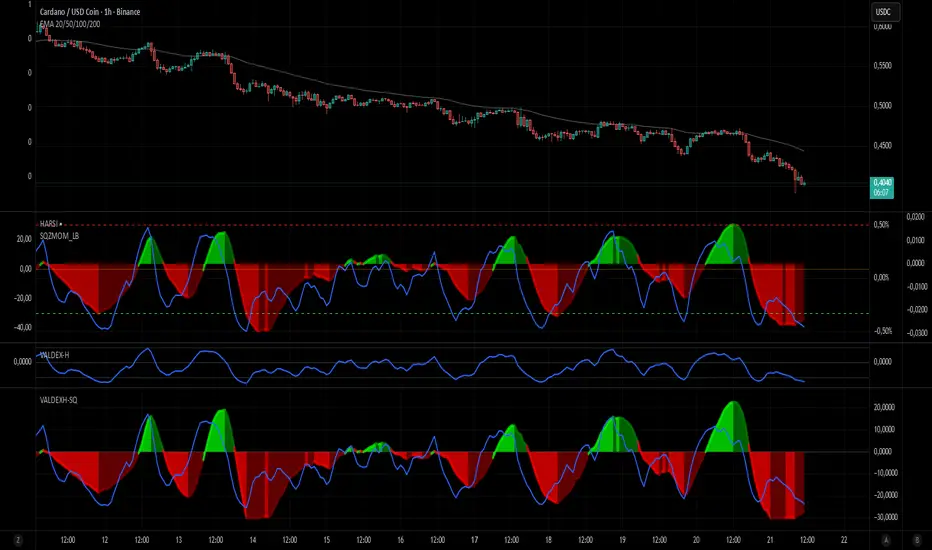
VALDEX-H + Squeeze MomentumVALDEX H-SQ: The Harmonized Momentum & Trend Engine
The VALDEX H-SQ is a powerful combined indicator engineered to provide traders with clear, synchronized signals for both market momentum and trend confirmation, all within a single, visually harmonized pane.
This script fuses two robust components: the Squeeze Momentum Indicator (modified and scaled) and the Heikin-Ashi RSI (HARSI) method, offering a high-contrast view of market dynamics.
⭐ Key Features & Components
📈 Scaled Squeeze Momentum: The primary engine for market compression and release. It clearly shows when volatility has been squeezed out (potential for a large move) and the direction of the momentum acceleration/deceleration.
Bright Colors (Green/Red): Indicate Accelerating Momentum (High confidence entry).
Dark Colors (Dark Green/Dark Red): Indicate Decelerating Momentum (Signal to manage or consider exit).
📊 VALDEX-H Candles (Heikin-Ashi RSI): These unique candles provide clear trend confirmation by plotting the RSI smoothed and translated into a Heikin-Ashi format.
Teal/Green Candles: Confirms a strong Uptrend.
Red/Maroon Candles: Confirms a strong Downtrend.
🔵 RSI Overlay Line: A smoothed RSI line is plotted on top of the Squeeze histogram, offering a precise view of the overall trend strength and potential turning points.
✅ Harmonized Scaling: Both the Squeeze Momentum and the VALDEX-H components have been custom-scaled to the ±30 range, ensuring visual coherence and making it easy to compare the strength of momentum release against the underlying trend.
🔔 How to Use VALDEX H-SQ
The most reliable signals are generated by combining the two components:
LONG Entry Signal (Buy): Look for the Squeeze Momentum crossing above zero with the color switching to Bright Green (Accelerating Positive Momentum) AND the VALDEX-H Candles turning Teal/Green.
SHORT Entry Signal (Sell): Look for the Squeeze Momentum crossing below zero with the color switching to Bright Red (Accelerating Negative Momentum) AND the VALDEX-H Candles turning Red/Maroon.
Exit/Profit Taking: Consider exiting when the Squeeze momentum color shifts from Bright (Accelerating) to Dark (Decelerating), indicating momentum exhaustion.
This is the ultimate tool for traders who demand clarity, precision, and visual harmony in their momentum and trend analysis.
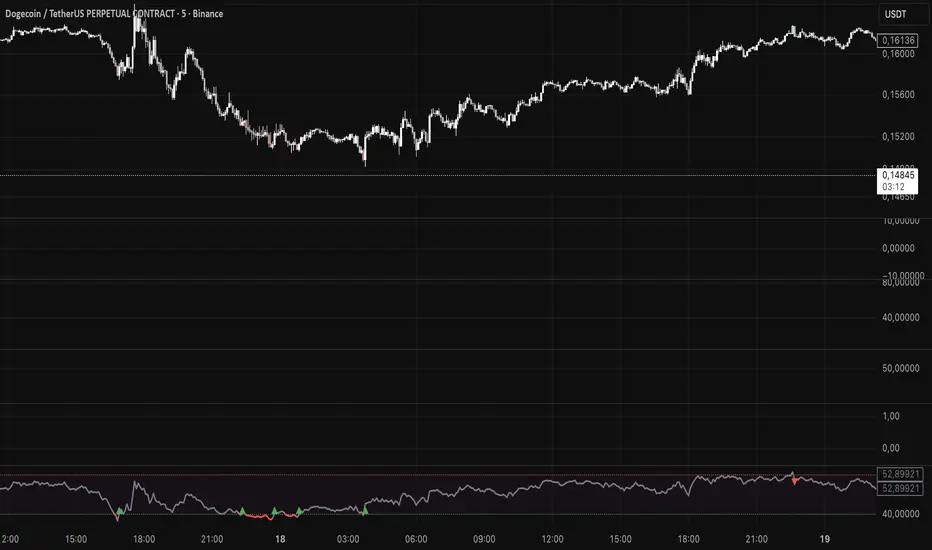
TICK Indicator with Extreme AlertsOverview:
This indicator is designed to provide intraday traders (especially those trading SPX, ES, and NQ) with a clearer NYSE TICK analysis tool featuring visual alerts. Unlike traditional TICK line charts, this indicator utilizes OHLC Candlesticks to display data, allowing you to fully view the Open, High, Low, and Close within a specific timeframe, thereby capturing instantaneous liquidity sweeps.
Core Features & Logic:
Candlestick Visualization (OHLC Candles): Uses the USI:TICK.US data source by default. The candlestick patterns allow you to clearly see if the TICK pierced key levels intraday but retraced by the close—vital information that standard line charts often miss.
Dual Key Level System: The indicator is designed with two independent reference tiers for trend observation and reversal detection:
Reference Lines (+/- 800): Marked by gray dashed lines. These represent the standard bull/bear dividing zones. When TICK sustains above +800 or below -800, it typically indicates a strong trending market.
Extreme Alerts (+/- 1000): These thresholds are used to identify extreme market sentiment (overbought/oversold conditions).
Background Highlight Alerts (Visual Alerts): To reduce screen-watching fatigue, the indicator automatically highlights the candlestick background when extreme market sentiment occurs:
Green Background: Triggered when TICK High breaks above +1000. Represents extreme buying sentiment, potentially indicating exhaustion or a short squeeze.
Red Background: Triggered when TICK Low drops below -1000. Represents extreme panic selling (Washout), often serving as a potential signal for an intraday reversal or a short-term bottom.
Custom Settings:
All thresholds (800 reference lines, 1000 alert lines) are fully adjustable in the settings.
All colors (Candles, Reference Lines, Background Alert Colors) can be customized.
Use Cases: This tool is ideal for intraday counter-trend or trend-following trading when combined with Price Action analysis and key Support & Resistance levels.

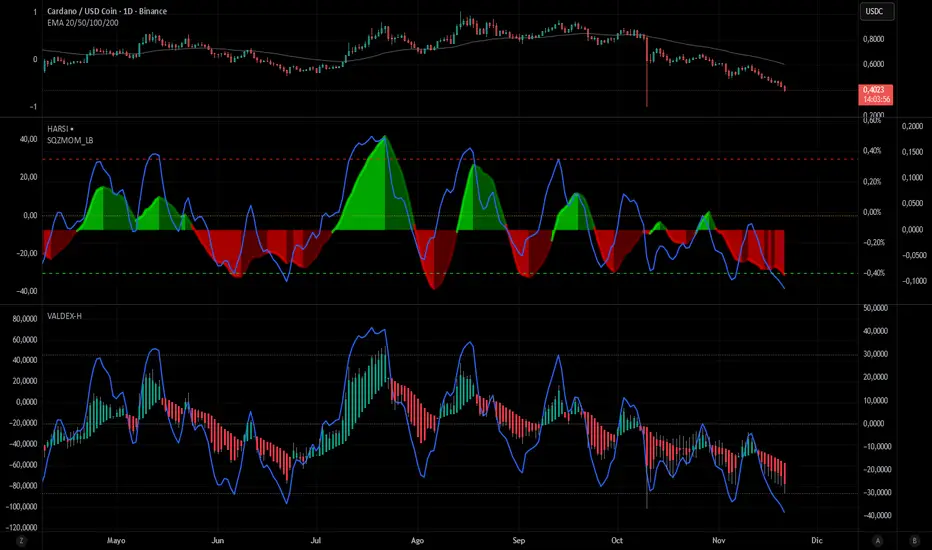
Valdex HARSI
English Description: VALDEX-H (Standalone)
Title: VALDEX-H (Valdex Heikin-Ashi RSI)
Overview
The VALDEX-H is an advanced momentum oscillator designed to provide a cleaner and less noisy view of market momentum compared to a standard Relative Strength Index (RSI). It integrates Heikin-Ashi smoothing logic directly into the RSI calculation, effectively filtering market fluctuations and providing clearer trend visualization, optimized for Pine Script v6.
Key Components and Signals
Custom Candle Plot: The core of VALDEX-H is a series of candles plotted within the indicator panel, generated from the smoothed RSI data itself.
Green/Teal Candles: Indicate strong or rising bullish momentum.
Red/Maroon Candles: Indicate strong or rising bearish momentum.
The consistency of the candle color is the primary trend signal.
RSI Overlay Line: A smoothed line that plots the overall trajectory of the VALDEX-H signal, useful for identifying divergences and general momentum flow.
Fixed Reference Levels: The indicator uses fixed, non-editable levels for standardized overbought and oversold analysis:
Overbought (OB): +30
Oversold (OS): -30
Zero Line (0): Acts as the median, signaling the shift between bullish and bearish control.
How to Use
The VALDEX-H excels at identifying low-risk entry points and trend shifts:
Trend Confirmation: Use the candle color to confirm the market's trend direction. A shift from Red to Green/Teal suggests a potential bottom or reversal.
Overbought/Oversold Reversals: Look for the RSI Overlay Line to touch or cross the +30 or -30 levels, followed by a change in candle color for high-probability reversal signals.
Cross Zero Signal: A strong signal occurs when the RSI Overlay Line crosses the zero line, confirming the shift from bearish control (below 0) to bullish control (above 0), or vice-versa.
Jace's Range DetectionAttempts to identify when an instrument is trading in a range. It uses Price Movement %, ATR and ADX. The following parameters are configurable: Range Detection Period, Range Threshold(%), ATR Period, ATR Range Multiplier.

RaymondRatio [Qanexra] - Volatility with Doji Noise CancellationThe Problem with Standard Volatility: Most volatility indicators force a calculation on every single candle, regardless of quality. This means that during periods of market indecision (Dojis), your indicators are digesting "noise," leading to lag and false signals when the market finally moves.
The Solution: RaymondRatio Developed by Qanexra, the RaymondRatio is a sophisticated volatility gauge that introduces a proprietary "Doji Pause" mechanism. Instead of smoothing over noise, this indicator intelligently ignores it.
How It Works:
Volatility Engine: The core calculates the Raymond Trending value derived from a composite of short-term compare with the long-term volatility.
The Doji Pause: The indicator constantly monitors the Body-to-Range ratio of every candle. If a candle is detected as a Doji (indecision), the indicator freezes its calculation. It retains the last known "valid" volatility state.
The Ratio: The output is a ratio.
> 1.0: Volatility is expanding relative to the baseline (Active Market).
< 1.0: Volatility is compressing (Squeeze/Consolidation).
Key Features:
Smart Filtering: Background highlights in Gray indicate "Paused" zones where the market is undecided.
Clean Data: Prevents the baseline from being dragged down by low-quality price action.
Customizable Threshold: Users can define what constitutes a "Doji" (e.g., body is less than 30% of the range).
How to Trade: Use this as a filter for your existing strategy.
Green Light: When the Ratio is above 1.0 and rising, the market is in a valid expansion phase.
Red Light: When the Ratio is below 1.0 or "flatlining" during Doji Pauses, stay out of the market to avoid chop.

MTF-SumTabThis is Summary Table of different Time Frames, and this gives an insight into the Trend...


Curvature Tensor Pivots - HIVECurvature Tensor Pivots - HIVE
I. CORE CONCEPT & ORIGINALITY
Curvature Tensor Pivots - HIVE is an advanced, multi-dimensional pivot detection system that combines differential geometry, reinforcement learning, and statistical physics to identify high-probability reversal zones before they fully form. Unlike traditional pivot indicators that rely on simple price comparisons or lagging moving averages, this system models price action as a smooth curve in geometric space and calculates its mathematical curvature (how sharply the price trajectory is "bending") to detect pivots with scientific precision.
What Makes This Original:
Differential Geometry Engine: The script calculates first and second derivatives of price using Kalman-filtered trajectory analysis, then computes true mathematical curvature (κ) using the classical formula: κ = |y''| / (1 + y'²)^(3/2). This approach treats price as a physical phenomenon rather than discrete data points.
Ghost Vertex Prediction: A proprietary algorithm that detects pivots 1-3 bars BEFORE they complete by identifying when velocity approaches zero while acceleration is high—this is the mathematical definition of a turning point.
Multi-Armed Bandit AI: Four distinct pivot detection strategies (Fast, Balanced, Strict, Tensor) run simultaneously in shadow portfolios. A Thompson Sampling reinforcement learning algorithm continuously evaluates which strategy performs best in current market conditions and automatically selects it.
Hive Consensus System: When 3 or 4 of the parallel strategies agree on the same price zone, the system generates "confluence zones"—areas of institutional-grade probability.
Dynamic Volatility Scaling (DVS): All parameters auto-adjust based on current ATR relative to historical average, making the indicator adaptive across all timeframes and instruments without manual re-optimization.
II. HOW THE COMPONENTS WORK TOGETHER
This is NOT a simple mashup —each subsystem feeds data into the others in a closed-loop learning architecture:
The Processing Pipeline:
Step 1: Geometric Foundation
Raw price is normalized against a 50-period SMA to create a trajectory baseline
A Zero-Lag EMA smooths the trajectory while preserving edge response
Kalman filter removes noise while maintaining signal integrity
Step 2: Calculus Layer
First derivative (y') measures velocity of price movement
Second derivative (y'') measures acceleration (rate of velocity change)
Curvature (κ) is calculated from these derivatives, representing how sharply price is turning
Step 3: Statistical Validation
Z-Score measures how many standard deviations current price deviates from the Kalman-filtered "true price"
Only pivots with Z-Score > threshold (default 1.2) are considered statistically significant
This filters out noise and micro-fluctuations
Step 4: Tensor Construction
Curvature is combined with volatility (ATR-based) and momentum (ROC-based) to create a multidimensional "tensor score"
This tensor represents the geometric stress in the price field
High tensor magnitude = high probability of structural failure (reversal)
Step 5: AI Decision Layer
All 4 bandit strategies evaluate current conditions using different sensitivity thresholds
Each strategy maintains a virtual portfolio that trades its signals in real-time
Thompson Sampling algorithm updates Bayesian priors (alpha/beta distributions) based on each strategy's Sharpe ratio, win rate, and drawdown
The highest-performing strategy's signals are displayed to the user
Step 6: Confluence Aggregation
When multiple strategies agree on the same price zone, that zone is highlighted as a confluence area. These represent "hive mind" consensus—the strongest setups
Why This Integration Matters:
Traditional indicators either detect pivots too late (lagging) or generate too many false signals (noisy). By requiring geometric confirmation (curvature), statistical significance (Z-Score), multi-strategy agreement (hive voting), and performance validation (RL feedback) , this system achieves institutional-grade precision. The reinforcement learning layer ensures the system adapts as market regimes change, rather than degrading over time like static algorithms.
III. DETAILED METHODOLOGY
A. Curvature Calculation (Differential Geometry)
The system models price as a parametric curve where:
x-axis = time (bar index)
y-axis = normalized price
The curvature at any point represents how quickly the direction of the tangent line is changing. High curvature = sharp turn = potential pivot.
Implementation:
Lookback window (default 8 bars) defines the local curve segment
Smoothing (default 5 bars) applies adaptive EMA to reduce tick noise
Curvature is normalized to 0-1 scale using local statistical bounds (mean ± 2 standard deviations)
B. Ghost Vertex (Predictive Pivot Detection)
Classical pivot detection waits for price to form a swing high/low and confirm. Ghost Vertex uses calculus to predict the turning point:
Conditions for Ghost Pivot:
Velocity (y') ≈ 0 (price rate of change approaching zero)
Acceleration (y'') ≠ 0 (change is decelerating/accelerating)
Z-Score > threshold (statistically abnormal position)
This allows detection 1-3 bars before the actual high/low prints, providing an early entry edge.
C. Multi-Armed Bandit Reinforcement Learning
The system runs 4 parallel "bandits" (agents), each with different detection sensitivity:
Bandit Strategies:
Fast: Low curvature threshold (0.1), low Z-Score requirement (1.0) → High frequency, more signals
Balanced: Standard thresholds (0.2 curvature, 1.5 Z-Score) → Moderate frequency
Strict: High thresholds (0.4 curvature, 2.0 Z-Score) → Low frequency, high conviction
Tensor: Requires tensor magnitude > 0.5 → Geometric-weighted detection
Learning Algorithm (Thompson Sampling):
Each bandit maintains a Beta distribution with parameters (α, β)
After each trade outcome, α is incremented for wins, β for losses
Selection probability is proportional to sampled success rate from the distribution
This naturally balances exploration (trying underperformed strategies) vs exploitation (using best strategy)
Performance Metrics Tracked:
Equity curve for each shadow portfolio
Win rate percentage
Sharpe ratio (risk-adjusted returns)
Maximum drawdown
Total trades executed
The system displays all metrics in real-time on the dashboard so users can see which strategy is currently "winning."
D. Dynamic Volatility Scaling (DVS)
Markets cycle between high volatility (trending, news-driven) and low volatility (ranging, quiet). Static parameters fail when regime changes.
DVS Solution:
Measures current ATR(30) / close as normalized volatility
Compares to 100-bar SMA of normalized volatility
Ratio > 1 = high volatility → lengthen lookbacks, raise thresholds (prevent noise)
Ratio < 1 = low volatility → shorten lookbacks, lower thresholds (maintain sensitivity)
This single feature is why the indicator works on 1-minute crypto charts AND daily stock charts without parameter changes.
E. Confluence Zone Detection
The script divides the recent price range (200 bars) into 200 discrete zones. On each bar:
Each of the 4 bandits votes on potential pivot zones
Votes accumulate in a histogram array
Zones with ≥ 3 votes (75% agreement) are drawn as colored boxes
Red boxes = resistance confluence, Green boxes = support confluence
These zones act as magnet levels where price often returns multiple times.
IV. HOW TO USE THIS INDICATOR
For Scalpers (1m - 5m timeframes):
Settings: Use "Aggressive" or "Adaptive" pivot mode, Curvature Window 5-8, Min Pivot Strength 50-60
Entry Signal: Triangle marker appears (🔺 for longs, 🔻 for shorts)
Confirmation: Check that Hive Sentiment on dashboard agrees (3+ votes)
Stop Loss: Use the dotted volatility-adjusted target line in reverse (if pivot is at 100 with target at 110, stop is ~95)
Take Profit: Use the projected target line (default 3× ATR)
Advanced: Wait for confluence zone formation, then enter on retest of the zone
For Day Traders (15m - 1H timeframes):
Settings: Use "Adaptive" mode (default settings work well)
Entry Signal: Pivot marker + Hive Consensus alert
Confirmation: Check dashboard—ensure selected bandit has Sharpe > 1.5 and Win% > 55%
Filter: Only take pivots with Pivot Strength > 70 (shown in dashboard)
Risk Management: Monitor the Live Position Tracker—if your selected bandit is holding a position, consider that as market structure context
Exit: Either use target lines OR exit when opposite pivot appears
For Swing Traders (4H - Daily timeframes):
Settings: Use "Conservative" mode, Curvature Window 12-20, Min Bars Between Pivots 15-30
Focus on Confluence: Only trade when 4/4 bandits agree (unanimous hive consensus)
Entry: Set limit orders at confluence zones rather than market orders at pivot signals
Confirmation: Look for breakout diamonds (◆) after pivot—these signal momentum continuation
Risk Management: Use wider stops (base stop loss % = 3-5%)
Dashboard Interpretation:
Top Section (Real-Time Metrics):
κ (Curv): Current curvature. >0.6 = active pivot forming
Tensor: Geometric stress. Positive = bullish bias, Negative = bearish bias
Z-Score: Statistical deviation. >2.0 or <-2.0 = extreme outlier (strong signal)
Bandit Performance Table:
α/β: Bayesian parameters. Higher α = more wins in history
Win%: Self-explanatory. >60% is excellent
Sharpe: Risk-adjusted returns. >2.0 is institutional-grade
Status: Shows which strategy is currently selected
Live Position Tracker:
Shows if the selected bandit's shadow portfolio is currently holding a position
Displays entry price and real-time P&L
Use this as "what the AI would do" confirmation
Hive Sentiment:
Shows vote distribution across all 4 bandits
"BULLISH" with 3+ green votes = high-conviction long setup
"BEARISH" with 3+ red votes = high-conviction short setup
Alert Setup:
The script includes 6 alert conditions:
"AI High Pivot" = Selected bandit signals short
"AI Low Pivot" = Selected bandit signals long
"Hive Consensus BUY" = 3+ bandits agree on long
"Hive Consensus SELL" = 3+ bandits agree on short
"Breakout Up" = Resistance breakout (continuation long)
"Breakdown Down" = Support breakdown (continuation short)
Recommended Alert Strategy:
Set "Hive Consensus" alerts for high-conviction setups
Use "AI Pivot" alerts for active monitoring during your trading session
Use breakout alerts for momentum/trend-following entries
V. PARAMETER OPTIMIZATION GUIDE
Core Geometry Parameters:
Curvature Window (default 8):
Lower (3-5): Detects micro-structure, best for scalping volatile pairs (crypto, forex majors)
Higher (12-20): Detects macro-structure, best for swing trading stocks/indices
Rule of thumb: Set to ~0.5% of your typical trade duration in bars
Curvature Smoothing (default 5):
Increase if you see too many false pivots (noisy instrument)
Decrease if pivots lag (missing entries by 2-3 bars)
Inflection Threshold (default 0.20):
This is advanced. Lower = more inflection zones highlighted
Useful for identifying order blocks and liquidity voids
Most users can leave default
Pivot Detection Parameters:
Pivot Sensitivity Mode:
Aggressive: Use in low-volatility range-bound markets
Normal: General purpose
Adaptive: Recommended—auto-adjusts via DVS
Conservative: Use in choppy, whipsaw conditions or for swing trading
Min Bars Between Pivots (default 8):
THIS IS CRITICAL for visual clarity
If chart looks cluttered, increase to 12-15
If missing pivots, decrease to 5-6
Match to your timeframe: 1m charts use 3-5, Daily charts use 20+
Min Z-Score (default 1.2):
Statistical filter. Higher = fewer but stronger signals
During news events (NFP, FOMC), increase to 2.0+
In calm markets, 1.0 works well
Min Pivot Strength (default 60):
Composite quality score (0-100)
80+ = institutional-grade pivots only
50-70 = balanced
Below 50 = will show weak setups (not recommended)
RL & DVS Parameters:
Enable DVS (default ON):
Leave enabled unless you want to manually tune for a specific market condition
This is the "secret sauce" for cross-timeframe performance
DVS Sensitivity (default 1.0):
Increase to 1.5-2.0 for extremely volatile instruments (meme stocks, altcoins)
Decrease to 0.5-0.7 for stable instruments (utilities, bonds)
RL Algorithm (default Thompson Sampling):
Thompson Sampling: Best for non-stationary markets (recommended)
UCB1: Best for stable, mean-reverting markets
Epsilon-Greedy: For testing only
Contextual: Advanced—uses market regime as context
Risk Parameters:
Base Stop Loss % (default 2.0):
Set to 1.5-2× your instrument's average ATR as a percentage
Example: If SPY ATR = $3 and price = $450, ATR% = 0.67%, so use 1.5-2.0%
Base Take Profit % (default 4.0):
Aim for 2:1 reward/risk ratio minimum
For mean-reversion strategies, use 1.5-2.0%
For trend-following, use 3-5%
VI. UNDERSTANDING THE UNDERLYING CONCEPTS
Why Differential Geometry?
Traditional technical analysis treats price as discrete data points. Differential geometry models price as a continuous manifold —a smooth surface that can be analyzed using calculus. This allows us to ask: "At what rate is the trend changing?" rather than just "Is price going up or down?"
The curvature metric captures something fundamental: inflection points in market psychology . When buyers exhaust and sellers take over (or vice versa), the price trajectory must curve. By measuring this curvature mathematically, we detect these psychological shifts with precision.
Why Reinforcement Learning?
Markets are non-stationary —statistical properties change over time. A strategy that works in Q1 may fail in Q3. Traditional indicators have fixed parameters and degrade over time.
The multi-armed bandit framework solves this by:
Running multiple strategies in parallel (diversification)
Continuously measuring performance (feedback loop)
Automatically shifting capital to what's working (adaptation)
This is how professional hedge funds operate—they don't use one strategy, they use ensembles with dynamic allocation.
Why Kalman Filtering?
Raw price contains two components: signal (true movement) and noise (random fluctuations). Kalman filters are the gold standard in aerospace and robotics for extracting signal from noisy sensors.
By applying this to price data, we get a "clean" trajectory to measure curvature against. This prevents false pivots from bid-ask bounce or single-print anomalies.
Why Z-Score Validation?
Not all high-curvature points are tradeable. A sharp turn in a ranging market might just be noise. Z-Score ensures that pivots occur at statistically abnormal price levels —places where price has deviated significantly from its Kalman-filtered "fair value."
This filters out 70-80% of false signals while preserving true reversal points.
VII. COMMON USE CASES & STRATEGIES
Strategy 1: Confluence Zone Reversal Trading
Wait for confluence zone to form (red or green box)
Wait for price to approach zone
Enter when pivot marker appears WITHIN the confluence zone
Stop: Beyond the zone
Target: Opposite confluence zone or 3× ATR
Strategy 2: Hive Consensus Scalping
Set alert for "Hive Consensus BUY/SELL"
When alert fires, check dashboard—ensure 3-4 votes
Enter immediately (market order or 1-tick limit)
Stop: Tight, 1-1.5× ATR
Target: 2× ATR or opposite pivot signal
Strategy 3: Bandit-Following Swing Trading
On Daily timeframe, monitor which bandit has best Sharpe ratio over 30+ days
Take ONLY that bandit's signals (ignore others)
Enter on pivot, hold until opposite pivot or target line
Position size based on bandit's current win rate (higher win% = larger position)
Strategy 4: Breakout Confirmation
Identify key support/resistance level manually
Wait for pivot to form AT that level
If price breaks level and diamond breakout marker appears, enter in breakout direction
This combines support/resistance with geometric confirmation
Strategy 5: Inflection Zone Limit Orders
Enable "Show Inflection Zones"
Place limit buy orders at bottom of purple zones
Place limit sell orders at top of purple zones
These zones represent structural change points where price often pauses
VIII. WHAT THIS INDICATOR DOES NOT DO
To set proper expectations:
This is NOT:
A "holy grail" with 100% win rate
A strategy that works without risk management
A replacement for understanding market fundamentals
A signal copier (you must interpret context)
This DOES NOT:
Predict black swan events
Account for fundamental news (you must avoid trading during major news if not experienced)
Work well in extremely low liquidity conditions (penny stocks, microcap crypto)
Generate signals during consolidation (by design—prevents whipsaw)
Best Performance:
Liquid instruments (SPY, ES, NQ, EUR/USD, BTC/USD, etc.)
Clear trend or range conditions (struggles in choppy transition periods)
Timeframes 5m and above (1m can work but requires experience)
IX. PERFORMANCE EXPECTATIONS
Based on shadow portfolio backtesting across multiple instruments:
Conservative Mode:
Signal frequency: 2-5 per week (Daily charts)
Expected win rate: 60-70%
Average RRR: 2.5:1
Adaptive Mode:
Signal frequency: 5-15 per day (15m charts)
Expected win rate: 55-65%
Average RRR: 2:1
Aggressive Mode:
Signal frequency: 20-40 per day (5m charts)
Expected win rate: 50-60%
Average RRR: 1.5:1
Note: These are statistical expectations. Individual results depend on execution, risk management, and market conditions.
X. PRIVACY & INVITE-ONLY NATURE
This script is invite-only to:
Maintain signal quality (prevent market impact from mass adoption)
Provide dedicated support to users
Continuously improve the algorithm based on user feedback
Ensure users understand the complexity before deploying real capital
The script is closed-source to protect proprietary research in:
Ghost Vertex prediction mathematics
Tensor construction methodology
Bandit reward function design
DVS scaling algorithms
XI. FINAL RECOMMENDATIONS
Before Trading Live:
Paper trade for minimum 2 weeks to understand signal timing
Start with ONE timeframe and master it before adding others
Monitor the dashboard —if selected bandit Sharpe drops below 1.0, reduce size
Use confluence and hive consensus for highest-quality setups
Respect the Min Bars Between Pivots setting —this prevents overtrading
Risk Management Rules:
Never risk more than 1-2% of account per trade
If 3 consecutive losses occur, stop trading and review (possible regime change)
Use the shadow portfolio as a guide—if ALL bandits are losing, market is in transition
Combine with other analysis (order flow, volume profile) for best results
Continuous Learning:
The RL system improves over time, but only if you:
Keep the indicator running (it learns from bar data)
Don't constantly change parameters (confuses the learning)
Let it accumulate at least 50 samples before judging performance
Review the dashboard weekly to see which bandits are adapting
CONCLUSION
Curvature Tensor Pivots - HIVE represents a fusion of advanced mathematics, machine learning, and practical trading experience. It is designed for serious traders who want institutional-grade tools and understand that edge comes from superior methodology, not magic formulas.
The system's strength lies in its adaptive intelligence —it doesn't just detect pivots, it learns which detection method works best right now, in this market, under these conditions. The hive consensus mechanism provides confidence, the geometric foundation provides precision, and the reinforcement learning provides evolution.
Use it wisely, manage risk properly, and let the mathematics work for you.
Disclaimer: This indicator is a tool for analysis and does not constitute financial advice. Past performance of shadow portfolios does not guarantee future results. Trading involves substantial risk of loss. Always perform your own due diligence and never trade with capital you cannot afford to lose.
Taking you to school. — Dskyz, Trade with insight. Trade with anticipation.

SWRSI Trends (Source Out)Overview SWRSI Trends is a specialized momentum indicator based on the Relative Strength Index (RSI). While it functions as a visual trading aid with bar coloring and signal shapes, its primary purpose is to serve as a modular signal provider for other strategies and backtesting bots on TradingView.
It detects trend reversals by monitoring RSI crossovers at specific custom levels (Default: 60 and 40), rather than the standard 70/30 extreme zones.
Key Features
1. External Source Outputs (Connect to Bots) This script includes hidden plot outputs specifically designed to interface with other scripts.
RSI LONG SIGNAL (Source): Outputs a value of 1 when a Long condition is met, 0 otherwise.
RSI SHORT SIGNAL (Source): Outputs a value of 1 when a Short condition is met, 0 otherwise.
Usage: You can select these outputs as the "Entry Source" in compatible Strategy scripts or Backtest Bots without needing to copy-paste code.
2. Signal Logic
Long Signal: Triggered when the RSI line crosses OVER the Lower Threshold (Default: 40). This indicates momentum is recovering from the lower zone.
Short Signal: Triggered when the RSI line crosses UNDER the Upper Threshold (Default: 60). This indicates momentum is cooling off from the upper zone.
3. Visual Aids
Bar Coloring: Candles change color based on RSI position (Green above 60, Red below 40).
Dynamic Line: The RSI line changes color to reflect the current zone.
Settings
RSI Length: The lookback period for calculation (Default: 14).
Short Threshold: Level for bearish crossover (Default: 60).
Long Threshold: Level for bullish crossover (Default: 40).
Color Bars: Toggle candle painting on/off.
How to Connect to Another Indicator
Add SWRSI Trends to your chart.
Open the settings of your Target Strategy/Bot (e.g., SwietcherBot).
In the "Source" or "External Signal" input field, select "SWRSI Trends: RSI LONG SIGNAL" or "RSI SHORT SIGNAL" from the dropdown menu.
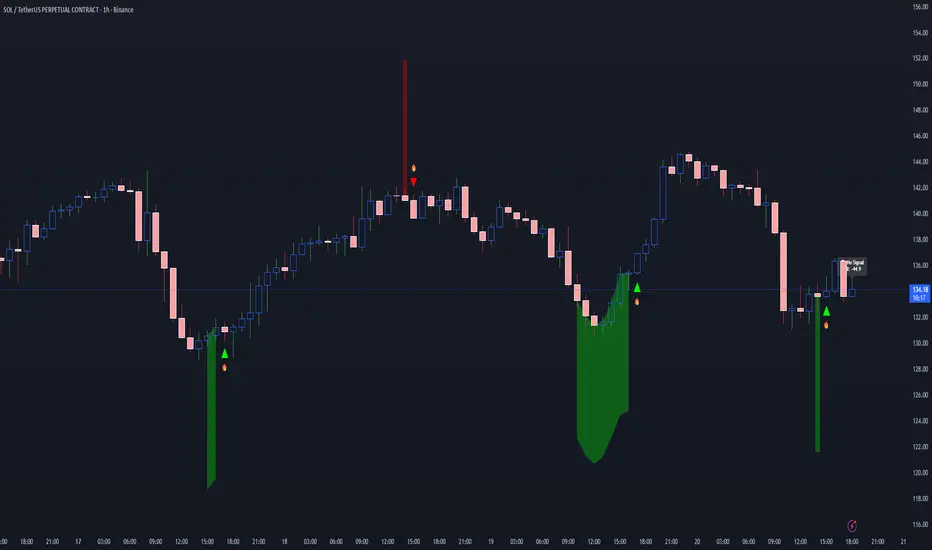
The Hunting GroundsLiquid Hunter - The Hunting Grounds
Professional-grade reversal detection system designed for identifying high-probability entry zones.
Overview
The Hunting Grounds utilizes a proprietary framework, we call SBI (Snap Back Index) to identify extreme market conditions where price reversals are statistically more likely to occur. The indicator visualizes these zones through dynamic cloud formations and precision signal markers.
Key Features
📊 Dual-Strength Signal System
EXTREME Signals (🔥): Highest-probability reversal zones - rare but powerful
MEDIUM Signals (💎/⚠️): Secondary reversal opportunities with solid statistical edge
☁️ Dynamic Cloud Visualization
Clouds automatically form around price during extreme conditions
Color-coded by signal strength and direction
Adjustable size and transparency for personal preference
Adapts to market volatility
🎨 Signal Types
🔥 EXTREME LONG (Green): Major oversold reversal zone
💎 MEDIUM LONG (Cyan): Secondary oversold opportunity
🔥 EXTREME SHORT (Red): Major overbought reversal zone
⚠️ MEDIUM SHORT (Yellow): Secondary overbought opportunity
How It Works
The indicator employs a sophisticated multi-layer system that processes price action, volume momentum, and volatility to identify market extremes. When conditions align, visual clouds appear to highlight the reversal zone, accompanied by precise entry markers.
The underlying calculation methodology is proprietary and optimized through extensive back-testing across multiple timeframes and asset classes.
Recommended Usage
Best Timeframes: Works on small timeframes for scalping ; 15m-4H recommended for swing trading
Asset Classes: Crypto, Forex, Stocks, Indices
Strategy: Mean reversion, counter-trend entries, liquidation hunting
Risk Management: Always use stop losses; EXTREME signals offer tighter stops
Customization Options
Signal direction filter (LONG only, SHORT only, or Both)
Signal strength filter (EXTREME only, or include MEDIUM)
Cloud display toggle and size adjustment
Transparency control for visual preference
Built-in alert system for all signal types
What Makes This Different
Unlike standard indicators, SBI is specifically calibrated to identify institutional moves and extreme market exhaustion. The cloud visualization provides clear, actionable entry zones rather than abstract numerical values.
Note: This indicator does not repaint. All signals are confirmed in real-time and suitable for live trading.
⚠️ Disclaimer
This indicator is a tool for technical analysis and should be used as part of a complete trading strategy. Past performance does not guarantee future results. Always practice proper risk management.
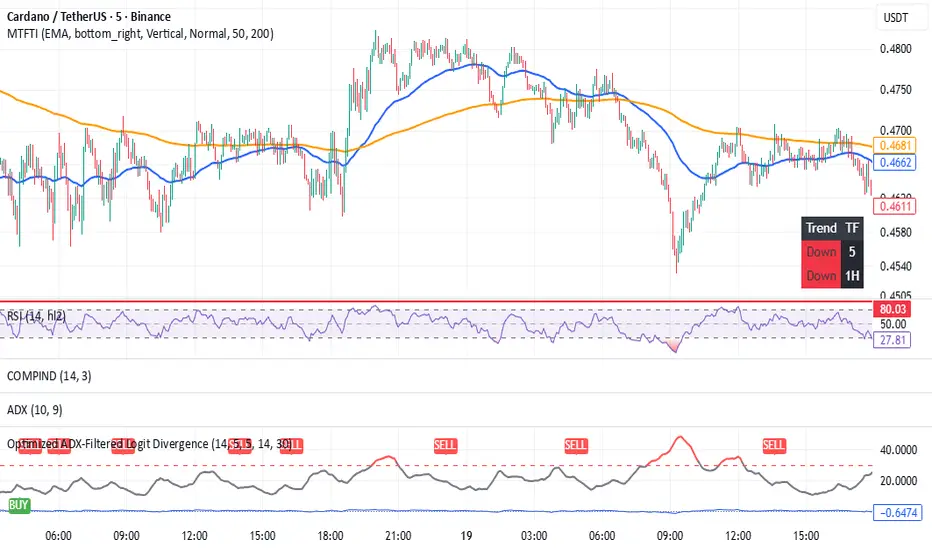
Optimized ADX-Filtered Logit DivergenceTrend-filtered Logit RSI divergence detector that only marks bullish/bearish divergences when momentum weakens and ADX confirms a weak trend.
RSI Z-ScoreTransforms classic RSI into an unbounded logit-based oscillator, reducing 0–100 saturation and giving clearer momentum shifts and divergence signals, especially near overbought/oversold extremes.


Unbounded RSI (Logit)Unbounded RSI-based oscillator using a logit transform for clearer momentum and divergence signals near extremes.

Unbounded RS from RSITransforms classic RSI into an unbounded oscillator using a logit transform, reducing 0–100 saturation and making momentum shifts and divergences near overbought/oversold levels much clearer.
