Market Direction 1Market Direction 1 is a multi-timeframe bias-mapping tool designed to display the current and previous daily directional conditions directly on intraday charts. The script compares the relationship between recent highs, lows, opens, and closes to determine whether the market is showing a bullish bias, bearish bias, or consolidation relative to prior daily ranges.
The indicator plots levels based on the detected bias and allows full customization of color, style, extension, and history depth for bullish, bearish, and consolidation conditions. It can optionally display a compact on-chart table summarizing both the Daily bias and the bias of the active timeframe when applicable.
This tool assists with visual market-state recognition and provides a structured view of directional context. It does not generate trading signals or suggest trading decisions.
Sentiment

BSSSv2BSSSv2 is a market-structure-based tool designed to highlight potential liquidity zones and liquidity voids on the chart. It detects recurring pivot-based price levels using a custom zigzag structure and marks buyside and sellside liquidity areas with dynamic boxes and lines. The script also tracks breaches of these zones and visually updates levels as new structure forms. Optional liquidity-void visualization is included for users who want to study displacement or imbalance behavior.
This tool is intended for chart analysis and helps traders observe how price interacts with liquidity-related areas. It does not provide trade signals or recommendations.

NSE Sector & Index ScannerDescription
Unlock the full picture of the Indian Stock Market with this all-in-one Sector & Index Scanner.
This robust indicator is designed for traders who need a bird's-eye view of market rotation and sector performance. It eliminates the noise and focuses on what matters: Trend, Momentum, and Volume.
🚀 Key Features
1. Comprehensive Sector Dashboard
Track 30+ Indices: Covers everything from Major Indices (Nifty 50, Bank Nifty) to specific sectors (Auto, IT, Pharma, Defence) and thematic indices (PSE, MNC, Commodities).
Dual-Timeframe Analysis:
21D % (Monthly Trend): Identify the dominant trend.
Day % (Intraday Action): Spot immediate price action and breakouts.
Relative Strength (RS): Instantly see which sectors are outperforming the Benchmark (Nifty 50).
2. Smart Volume Detection
Volume Icons (⚡): A lightning bolt icon appears next to the "Day %" when volume is 1.5x higher than the average, signaling institutional participation.
3. Market Breadth Gauge
Real-time Health Check: Visualizes the percentage of sectors that are Bullish, Neutral, or Bearish.
Market Bias: Auto-detects the overall market mood (e.g., "SIDEWAYS (Positive Bias)", "BULLISH").
4. Dynamic Sorting & Visuals
Auto-Sorting: Automatically ranks sectors from Strongest to Weakest.
Heatmap Coloring: Intuitive background colors (Green/Red) help you spot leaders and laggards instantly.
Top Leaders Label: Displays the top 3 performing sectors directly on the chart for quick reference.
🛠️ Settings & Customization
Momentum Lookback: Adjust the period for trend calculation (Default: 21 days).
Chart Display Mode: Switch between plotting "Sectors" lines or the "Market Breadth" histogram.
Benchmark: Change the RS comparison symbol (Default: NIFTY).
📋 How to Use
Add the indicator to your chart (works best on Daily timeframe).
Use the Table to identify the strongest sectors (Green top rows).
Look for Volume (⚡) confirmation on sectors moving today.
Check RS to ensure you are trading the leaders, not the laggards.
Use Market Breadth to gauge if the overall environment supports long or short positions.

Nifty Participants - Top 10 📌 Nifty Participants – Top 10 (Indicator Description)
This indicator displays the top 10 weighted stocks from the NIFTY index and shows how each stock is contributing to the index movement in real time.
For each participant, the script calculates price change, percentage change, RSI, VWAP position, volume spike, previous day levels, and their estimated participation based on weightage.
A dynamic table is plotted on the chart with color-coded cells for bullish, bearish, and neutral conditions. Users can customize which columns to display (LTP, Change, Change %, Share, RSI, VWAP, Volume Spike, Previous Day High/Low) and select the timeframe for calculations. The index itself appears as the first row for quick comparison.
Volume spikes are highlighted when current volume exceeds a configurable multiple of the average volume. RSI and VWAP columns also use adaptive coloring to quickly show strength or weakness.
All weightages are user-editable, and the table automatically limits output to the selected number of rows. This makes it an ideal real-time market breadth and contribution tracker for intraday and positional traders.

Technology Stocks RSPSTechnology Stocks RSPS Indicator - TradingView Description
Overview
The Technology Stocks RSPS (Relative Strength Portfolio System) indicator is a sophisticated portfolio allocation tool designed specifically for technology sector stocks. It calculates relative strength positions and provides dynamic allocation recommendations based on technical price momentum analysis.
Key Features
- Relative Strength Analysis: Compares 15 major technology stocks and the XLK sector ETF
against each other and gold as a baseline
- Dynamic Portfolio Allocation: Automatically calculates optimal position sizes based on relative
performance
- Visual Portfolio Performance: Tracks cumulative portfolio returns with color-coded
performance indicators
- Customizable Table Display: Shows real-time allocation percentages and optional cash values
for each position
- Technical Momentum Filtering: Uses normalized indicators to identify strength and filter out
weak positions
Included Assets
Sector ETF: XLK
Major Tech Stocks: AAPL, MSFT, NVDA, AVGO, CRM, ORCL, CSCO, ADBE, ACN, AMD, IBM, INTC, NOW, TXN
Benchmark: Gold (TVC:GOLD)
How It Works
The indicator calculates a relative strength score for each asset by comparing it against:
Gold (baseline commodity)
All other technology stocks in the pool
The XLK sector ETF
Assets with positive relative strength receive portfolio allocations proportional to their strength scores. Weak or negative performers are automatically filtered out (allocated 0%).
Visual Elements
Red Area: Aggregate strength of major technology stocks
Navy Blue Area: Overall technical positioning index (TPI)
Performance Line: Cumulative portfolio return (blue = cash-heavy, red = equity-heavy)
Allocation Table: Bottom-left display showing current recommended positions
Important Limitations
This indicator primarily uses technical data and has significant limitations:
❌ No fundamental economic data (ISM, CLI, etc.)
❌ Limited monetary data - missing critical components:
comprehensive monetary data
Funding rates
Detailed bond spreads analysis
Collateral data
❌ No sentiment indicators
❌ No options flow or derivatives data
❌ No earnings or valuation metrics
The indicator focuses purely on price-based relative strength and technical momentum. Users should combine this tool with fundamental analysis, economic data, and proper risk management for complete investment decisions.
Settings
Plot Table: Toggle allocation table visibility
Use Cash: Enable to display dollar amounts based on portfolio size
Cash Amount: Set your total portfolio value for cash allocation calculations
Use Cases
Sector rotation within technology stocks
Relative strength-based portfolio rebalancing
Technical momentum screening for tech sector
Dynamic position sizing based on price trends
Technical Notes
The script avoids for-loops to reduce calculation errors and noise
Uses semi-individual calculations for each asset
Requires the Unicorpus/NormalizedIndicators/1 library for normalized momentum calculations
Maximum lookback: 100 bars
Disclaimer: This indicator is a technical tool only and should not be used as the sole basis for investment decisions. It does not incorporate fundamental, economic, or comprehensive monetary data. Always conduct thorough research and consider your risk tolerance before making investment decisions.

CE-PE Options Price Tracker - Call, Put, PCR, Calendar SpreadThis advanced TradingView indicator provides a real-time, side-by-side visualization of both Call and Put option price action for Indian derivatives—including Nifty
, BankNifty
, Sensex
, and major commodities.
Designed for active option traders, it simplifies scanning for directional bias, volatility, and premium flows at any user-selected strike.
Key Features:
Dual Option Candle Visualization: Instantly visualize both Call and Put prices as candlesticks for any selected strike—compare price action, structure, and momentum with clarity.
Premium Differential Tracking (C-P Diff): Analyze market skew and sentiment with live premium difference between Call and Put options.
Put-Call Ratio (PCR) Widget: Real-time PCR analysis and signal (Bullish/Bearish/Neutral) with custom threshold levels, helping you track sentiment shifts and trading triggers.
Calendar Spread Analysis: Easily spot arbitrage and hedging opportunities between near and next expiry dates for both Call and Put—coloured expansion/contraction signals keep you focused on volatility premium flows.
Volatility Panel: Live volatility calculation on both calls and puts, along with Buy/Sell signals to alert you of trend or momentum shifts based purely on option volatility.
User-Friendly Controls: Pick underlying, strike, expiry (including next expiry) and custom colour themes in seconds.
Visual Alerts: Candle and shape signals for key option price trend events and PCR reversals.
How to Use:
Apply this indicator to any Indian index or commodity options chart on TradingView.
Select the underlying, expiry, and strike to monitor.
All signals and premium data update in real time—supporting scalping, swing, or statistical strategies.
Best Suited For:
Directional option traders
Arbitrage and calendar spread specialists
PCR sentiment and volatility signal followers
Active intraday and expiry scalpers
Anyone wanting a fast options dashboard with intuitive dashboard-style visuals
Note:
This tool is designed for study and analysis only. Options trading involves significant risk.
Always combine technical analysis with risk management and consult a financial advisor if needed.

Market Sentiment [NeuraAlgo]
Market Sentiment
This indicator provides a real-time view of market momentum and sentiment by analyzing bullish and bearish impulses using price and volatility-based calculations. It visualizes trends on the chart and offers a dashboard with key statistics.
1.Status Calculation
The Status measures bullish momentum by identifying strong upward impulses.
Equation:
Status Source = Average of lows where(Low - High ) > ATR
For each bar, it checks if the current low minus the high from two bars ago exceeds the Average True Range (ATR) .
All lows that satisfy this condition are collected.
The average of these lows forms the Status Source , representing the level of strong buying pressure.
This helps traders visualize where significant bullish activity is concentrated and gauge upward momentum.
2.Status Source Calculation
Similarly, bearish impulses are detected by checking if highs fall below lows from two bars ago beyond ATR thresholds. The corresponding levels form the reference for selling pressure.
3. Trend Strength and States
Strength is Quantifies how far the price is from bullish or bearish reference levels as a percentage.
Trend States
Stability Phase (Gray): Market is quiet, minimal momentum.
Positive Flow (Green): Bullish pressure dominates; buyers are in control.
Negative Flow (Red): Bearish pressure dominates; sellers lead.
State Transition: Market is shifting; momentum is building.
4. Visuals
Bar colors indicate trend state: green for bullish, red for bearish, gray for neutral.
Filled zones highlight bullish and bearish reference levels for intuitive trend analysis.
5. Dashboard
An optional dashboard displays:
Sentiment: Visual gradient representing bullish or bearish dominance.
Status: Current trend state in concise, human-readable terms.
6. Purpose:
This indicator is designed to identify the current market status and the behavior of the asset by analyzing bullish and bearish impulses. It helps traders understand whether the market shows signs of stability, growth, or decline based on the asset’s price action and volatility.
Understand the asset behavior
Healthy asset behavior
Weak asset behavior
Market Sentiment combines price action, ATR-based volatility, and impulse tracking to provide a clear and actionable view of market conditions. The BullLine equation ensures that only meaningful bullish moves are highlighted, giving traders a reliable reference for momentum and potential entry points.

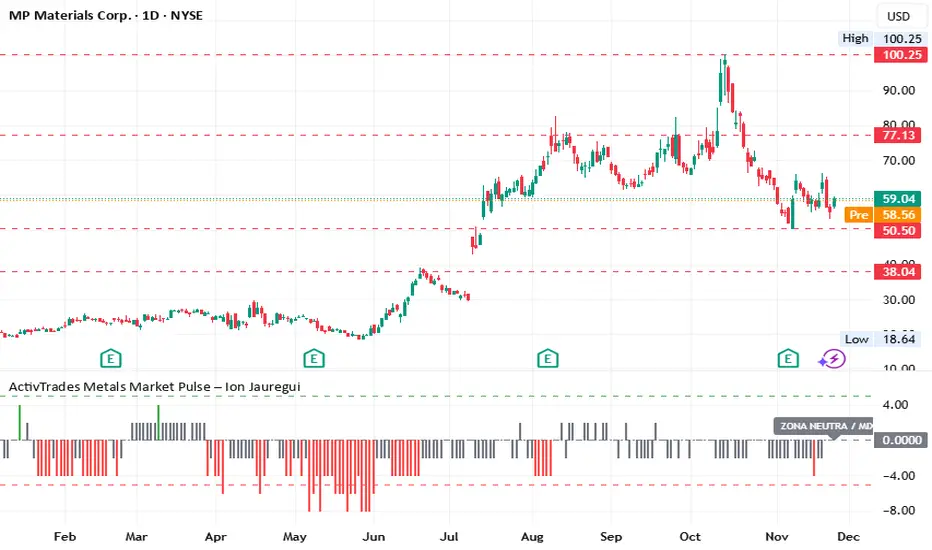
ActivTrades Metals Market Pulse – Ion JaureguiThe ActivTrades Metals Market Pulse Indicator is a market analysis tool designed to assess overall risk sentiment in the metals market. Rather than generating trade signals, it provides a snapshot of the prevailing environment, helping traders and analysts understand whether conditions favor risk-taking or caution.
How it Works:
The indicator combines two key metal market metrics:
Metals Performance:
Compares the performance of industrial metals with precious metals relative to their 50-day moving averages.
Stronger industrial metal performance indicates higher market risk tolerance (Risk-On), while stronger precious metal performance suggests increased risk aversion (Risk-Off).
Trend Momentum:
Uses a Bloomberg-style scoring system based on the relative position of each metal to its 50-day SMA.
Scores range visually from -5 to +5 to indicate overall market sentiment.
Risk Sentiment Index:
Each metal contributes to the total score, creating an index that oscillates between Risk-On (high risk appetite) and Risk-Off (heightened caution), with a neutral zone for mixed conditions.
Visual Output:
Results are displayed as a colored histogram for easy interpretation of metals market sentiment.
Labeled zones include:
Extreme Risk-On: Industrial metals strongly outperform precious metals.
Extreme Risk-Off: Precious metals strongly outperform industrial metals.
Neutral Zone / Mixed: No clear dominance; the market is balanced or sideways.
Purpose and Use:
Helps traders, analysts, and investors gauge prevailing risk appetite in the metals market.
Provides context for strategic positioning and risk management without offering direct trade recommendations.
*******************************************************************************************
The information provided does not constitute investment research. The material has not been prepared in accordance with the legal requirements designed to promote the independence of investment research and such should be considered a marketing communication.
All information has been prepared by ActivTrades ("AT"). The information does not contain a record of AT's prices, or an offer of or solicitation for a transaction in any financial instrument. No representation or warranty is given as to the accuracy or completeness of this information.
Any material provided does not have regard to the specific investment objective and financial situation of any person who may receive it. Past performance and forecasting are not a synonym of a reliable indicator of future performance. AT provides an execution-only service. Consequently, any person acting on the information provided does so at their own risk. Political risk is unpredictable. Central bank actions can vary. Platform tools do not guarantee success.
INDICATORS:
RISK ADVICE: The information and publications are not meant to be, and do not constitute, financial, investment, trading, or other types of advice or recommendations supplied or endorsed by ActivTrades. This script intends to help follow the trend and filter out market noise. This script is meant for the use of international users. This script is not meant for the use of Spain users.
Gold Thai CompassGold Thai Compass Indicator
Calculates Thai Gold Price (96.5%) by converting XAU/USD with the USD/THB exchange rate in real time
Displays the calculated gold_price_thb directly on the chart with a clean right-aligned label for easy price reading
Includes customizable reference lines — add, remove, rename, recolor, and adjust each line independently
Supports multiple editable lines (e.g., 4 levels) with price labels displayed beside each line
Provides user-friendly input settings (e.g., custom price sources, spread/adjustment options)
Updates dynamically with live market data — suitable for trading, analysis, and Thai gold price tracking
Designed for TradingView (Pine Script) and optimized for clarity and usability
Optional visibility controls to show/hide labels and reference lines for a cleaner chart layout

Dimagi72 Trend Suite (EMA/SMA + 52W + Cross Signals)Dimagi72 Trend Suite is an advanced trend analysis tool designed to give traders a clear picture of market direction, momentum, and major structural turning points.
It combines the most reliable long-term and short-term signals into one clean, easy-to-read indicator.
Features
• EMA9 & EMA21 for short-term momentum
• SMA50, SMA100, SMA200 for medium & long-term trend structure
• 52-Week High & Low levels for institutional support/resistance
• Golden Cross / Death Cross signals (SMA50 vs SMA200)
• Trend Strength Meter, shown directly on the chart
• Clean labels without clutter
• Designed for crypto, stocks, and forex on all timeframes (best on Daily)
How it works
The indicator measures alignment between EMAs and SMAs, tracks long-term institutional levels, and highlights major trend reversals through cross signals.
The Trend Strength Meter calculates a score from -4 to +4, making trend direction instantly visible.
Why use this indicator
This suite brings together the most widely used trend-following tools into one unified system.
It helps traders quickly determine when the market is bullish, bearish, or neutral — and when major reversals may be forming.
Best for:
Swing traders, long-term trend followers, crypto traders, and anyone who wants a clean visual overview of the trend without using multiple separate indicators.
Tags (use these to show up in search)
trend
ema
sma
trend-following
golden cross
death cross
momentum
trend strength
52 week high
crypto
stocks
market structure

Smart Money COTThis indicator implements the method of analysing COT data as defined by Michael Huddleston (I.E. The Inner Circle Trader). It removes all superfluous information contained in the standard COT reports and focusses only on Commercial speculators using the overall Long-Short positions.
Features
The unique feature of this indicator is its ability to look back over time and provide the following information:
Calculation of the range high and low of the specified lookback range.
Calculation of equilibrium of that range.
Automatic colour coding of net long and net short positions when the Long-Short COT calculation is above or below equilibrium of the lookback range.
Instructions
Use the Daily Timeframe only. You may get unexpected results on other timeframes.
Ensure the asset has COT data available. Script is mainly focused on commodity futures, such as ES, NQ, YM. It has not been tested against Forex.
You will need to define the "Lookback" setting in the script settings. Use the total number of trading days required for your analysis. E.g. if you want a 6 month COT analysis, use the measurement tool to count the quantity of daily candles between now and 6 months ago - use this as your Lookback setting. Adjust as needed for other lookback periods, e.g. 3 months, 12 months etc.
Other Info
The script provides the ability to customise colours in its settings.
Range High and Range Low plots can be disabled in settings.

Gold_Strategy_EMA_TradingProEC_v1.4We are pleased to announce a significant update to the execution logic of the Gold Breakouts Strategy, focusing on improved precision and reliability of trade signals.
📝 Summary of Key Changes
This version resolves the critical issue of duplicate or redundant trade entries that were being generated on the same bar when the EMA crossover condition was triggered. This caused unnecessary confusion in signal notifications and trade execution.
⚙️ Detailed Technical Implementation
Elimination of Redundant Code: We have successfully removed the conflicting entry logic block that previously attempted to execute trades using Pivot levels for Take Profit calculation. By doing this, we eliminate the source of the double entry problem.
Consolidated Execution Logic: The strategy now relies on a single, unified execution block. This block exclusively utilizes the robust Fixed TP/SL Ratio calculation as defined in the strategy inputs.
Enhanced Flow Control: We improved the conditional flow by using else if for the sell condition (else if cond_venta) immediately following the buy condition (if cond_compra). This vital change guarantees that if a Buy signal is processed on a given bar, the Sell signal logic is skipped entirely, making the execution flow more exclusive and robust against rapid market movements.
✅ User Impact and Benefits
Single, Clear Notifications: Users will now receive only one definitive entry notification per signal (either 'sell' or 'buy') at a time. This allows for immediate and confident decision-making.
Reliable Trade Execution: The strategy is now significantly more dependable, ensuring that the Stop Loss and Take Profit levels are set correctly and consistently based on the defined risk ratio immediately upon entry.

[MTX] Weekly Support & Resistance Weekly Support & Resistance
Overview
Discover key market structure with this all-in-one indicator:
Weekly Support & Resistance (SR) levels , Fair Value Gap (FVG) detection , and Automatic Fibonacci retracements .
Designed for MTX traders, it plots non-repainting weekly highs/lows/opens/closes, highlights unmitigated FVGs for potential imbalances, and auto-draws Fib levels, Perfect for swing/day traders on XAUUSD.
🚀 Key Features
- Weekly SR Levels : Plots previous week's High (resistance), Low (support), Open, and Close. Optional historical levels (Week -2/-3).
- SR Zones : Customizable % zones around levels for dynamic support/resistance bands. Fill colors for easy visualization.
- FVG Detection : Identifies bullish (green) and bearish (red) Fair Value Gaps on your chart timeframe.
- buy/sell Signals :
- Trend Filter : Optional EMA/SMA to filter signals
- Auto Fibonacci : auto-retracement with 20+ levels (0%, 23.6%, 38.2%, 50%, 61.8%, 100%, extensions to 423.6%, negatives). Custom colors, labels, and background fills.
- Alerts: Built-in for FVG creation/mitigation + all buy/sell signals. Set up once for real-time notifications.
⚠️ Important Disclaimer
This indicator is for educational and analysis purposes only. It provides visual tools and signals based on historical price action— not financial advice. Past performance ≠ future results. Trading involves risk; use proper risk management. Backtest thoroughly. No guarantees of profitability. Consult a financial advisor.
#tradingview #smc #MTX #fvg #fibonacci #supportresistance

XAUUSD Multi-Timeframe Bias Scanner🎯 Purpose & Overview
This is a sophisticated trading indicator that analyzes XAUUSD (Gold) across 5 different timeframes simultaneously to determine market bias and trend direction.
⚙️ Core Components
2. Bias Calculation Engine
The heart of the indicator uses 5 technical factors to score each timeframe:
Technical Factors (Weighted):
Moving Average Alignment (30 points)
Bullish: EMA(9) > EMA(21) > EMA(50)
Bearish: EMA(9) < EMA(21) < EMA(50)
Price vs MA Position (20 points)
Score increases when price above MAs
Score decreases when price below MAs
RSI Momentum (20 points)
Bullish: RSI > 60 or > 50
Bearish: RSI < 40 or < 50
MACD Signals (15 points)
Bullish: MACD line > Signal line AND > 0
Bearish: MACD line < Signal line AND < 0
Volume Confirmation (15 points)
Volume spikes with price movement add confirmation
📊 Timeframe Analysis
Five Timeframes Monitored:
5-minute - Short-term noise (10% weight)
15-minute - Intraday direction (15% weight)
1-hour - Key intraday bias (25% weight)
4-hour - Primary directional bias (30% weight)
1-day - Overall trend context (20% weight)
Bias Scoring System:
0-100 Scale (50 = Neutral)
STRONG BULLISH: ≥70 (Green)
BULLISH: 55-69 (Lime)
NEUTRAL: 46-54 (Gray)
BEARISH: 31-45 (Orange)
STRONG BEARISH: ≤30 (Red)
🎨 Visual Features
1. Comprehensive Table Display
pinescript
var table biasTable = table.new(position.top_right, 3, 7, ...)
Shows a color-coded table with:
Timeframe name
Numerical bias score (0-100)
Strength description with color coding
2. Chart Visual Indicators
Background coloring based on overall bias
Label markers for strong bullish/bearish conditions
Real-time label showing all timeframe scores
3. Alert System
Triggers when overall bias crosses 70 (bullish) or 30 (bearish)
Configurable with sound options
🔄 How It Processes Data
Data Flow:
Requests security data for each timeframe using request.security()
Calculates technical indicators for each TF separately
Scores each TF based on 5 technical factors
Computes weighted overall bias
Updates visual displays and checks alert conditions
💡 Trading Applications
Bullish Scenarios:
Multiple timeframes show bullish alignment
Higher timeframe bias supports lower timeframe direction
Overall score > 70 indicates strong bullish conviction
Bearish Scenarios:
Multiple timeframes show bearish alignment
Higher timeframe bias confirms lower timeframe moves
Overall score < 30 indicates strong bearish conviction
Conflict Detection:
When timeframes show conflicting biases
Caution required - market may be consolidating
Wait for alignment before taking trades
🎚️ Customization Options
Users can modify:
Timeframe weights
Technical indicator parameters
Alert thresholds
Visual display preferences
Scoring sensitivity
📈 XAUUSD Specific Optimizations
The indicator considers Gold's unique characteristics:
High volatility periods
ATR-based volatility adjustments
Volume confirmation for breakouts
Multiple timeframe confirmation for trend reliability
This creates a powerful tool for identifying high-probability trade setups in XAUUSD by ensuring traders have a complete multi-timeframe perspective before entering positions.

Altseason IndexDescription of the "Altseason Index" Indicator
The Altseason Index is a powerful and visually minimalist tool designed to objectively identify the onset and conclusion of an "altseason" in the cryptocurrency market. Moving beyond subjective speculation, this indicator employs a clear, mathematical methodology by comparing the performance of a broad basket of altcoins against Bitcoin.
🎯 Core Concept and Utility
An "Altseason" is a market period where altcoins (cryptocurrencies other than Bitcoin) consistently yield higher returns than BTC. This indicator empowers traders and investors to:
Objectively Identify Market Cycles: Precisely pinpoint when capital is actively rotating from Bitcoin into altcoins and vice versa.
Make Data-Driven Decisions: Adjust their strategy in a timely manner: increasing exposure to altcoins during an altseason or rotating back into BTC upon its conclusion.
Avoid Emotional Pitfalls: Steer clear of FOMO (Fear Of Missing Out) and base decisions on hard data rather than market noise.
⚙️ How the Calculation Works
1. Asset Selection: The indicator tracks the performance of 15 leading altcoins across various market segments (Layer 1s, DeFi, Meme, Payments), ensuring a representative sample.
2. Performance Comparison: For each altcoin, the percentage price change over the user-defined lookback period (default: 90 days) is calculated. This performance is then compared to BTC's performance over the same period.
3. Counting the "Outperformers": The index counts the number of altcoins that have "outperformed" BTC.
4. Calculating the Index: The Altseason Index value is the percentage of altcoins in the basket that are outperforming BTC. For example, a value of 60% means that 9 out of the 15 coins performed better than Bitcoin.
🛠️ Indicator Settings
The settings are kept simple and intuitive, allowing you to customize the indicator to your strategy:
Lookback Period (days) (Default: 90):
- Defines the time horizon for the performance calculation.
- Shorter Periods (30-60 days) react faster to new trends but may produce more false signals.
- Longer Periods (90-180 days) provide smoother and more reliable signals, capturing sustained macro-trends.
Altseason Threshold (%) (Default: 75%):
- This is the key parameter that defines what index value constitutes an official "altseason."
- A threshold of 75% means an altseason is declared when at least 11 out of the 15 altcoins (75%) are outperforming BTC.
- You can increase the threshold (e.g., to 85%) for more conservative and stronger signals, or decrease it (e.g., to 65%) for earlier entries.
📊 Interpreting the Readings and Signals
The indicator uses a clear color-coding system and levels for easy interpretation:
🔴 < 30%: "BTC SEASON"
Bitcoin is dominating. The market is in risk-off mode or a state of anticipation. Growth is concentrated in BTC.
⚪ 30% - 49%: "NEUTRAL"
A transitional phase. The market is uncertain. Some alts show strength, but there is no unified trend.
🔵 50% - 74%: "BULLISH"
Growing strength in altcoins. Capital is beginning to rotate actively. This can be an early stage of an altseason.
🟢 ≥ 75% (or your custom threshold): "ALTSEASON"
The active altseason phase. The vast majority of altcoins are rising faster than BTC. This is the period of maximum potential returns for alts.
Signal Markers:
Green Dot: Signals the potential start of an altseason (the index crosses above the threshold).
Red Dot: Signals the potential end of an altseason (the index crosses below the threshold).
ℹ️ Information Panel
The chart displays two clean information panels:
1. Main Info Label:
Current index value (e.g., ⟠ 80%).
Market status (ALTSEASON, BULLISH, etc.).
The ratio of outperforming altcoins (11/15 alts).
2. Dominance & Market Cap Panel:
Alts: Altcoin Dominance (the market cap share of all coins except BTC).
BTC: Bitcoin Dominance.
Market: Total cryptocurrency market capitalization in billions of USD. This helps assess the overall market context (bullish/bearish).
💎 Conclusion
The Altseason Index is your strategic companion for navigating the crypto markets. It transforms the complex task of identifying market cycles into a simple and visual process. Use it to confirm broad market trends, identify potential entry and exit points, and, most importantly, to maintain discipline in your trading strategy by filtering out noise and emotion.
Disclaimer: This indicator is a tool for analysis and does not constitute investment advice. All trading decisions are taken at your own risk.

AI Projection LevelsProjection Levels – AI-Driven Volatility Projection Grid
Projection Levels is a quantitative market geometry engine that transforms raw volatility into a structured, multi-layered projection grid.
It is designed to help traders identify natural price reaction corridors, exhaustion zones, and expansion targets using a volatility-normalized mathematical framework.
This is not a random fixed indicator – it behaves like a deterministic, AI-style volatility interpreter that adapts to changing market conditions.
Mathematical Core (Simplified)
The system is built around a Volatility Projection Field (VPF) defined conceptually as:
Px = O + (ATR_prev * M * lambda_x)
Where:
O = session anchor (adaptive open)
ATR_prev = volatility memory from the previous regime
M = projection multiplier
lambda_x = fractal expansion ratios:
{0.25, 0.50, 0.75, 1.00, 1.25, 1.50, 1.75, 2.00}
These ratios behave like probabilistic expansion bands derived from historical volatility clustering in financial time series.
Cluster Stabilization Layer
Markets don’t respect random decimals – they tend to gravitate around liquidity clusters.
To reflect this, the indicator applies a discrete price quantization filter:
Q(x) = round( x / step ) * step
Where:
step = user-defined cluster size (for example: 500 points for index futures)
This compresses prices into liquidity-aligned structural clusters, creating “price magnets” where:
Dealers tend to hedge
Liquidity concentrates
Traps and fakeouts often form
Breakouts can accelerate once clusters are left behind
Why It Feels “AI-Driven”
Pine Script cannot run deep neural networks directly, but this tool emulates AI-like behavior via:
Recursive volatility normalization
Multi-level fractal expansion logic
Cluster-aligned price projections
Dynamic label overlays that tag key expansion zones
Functionally, it behaves like a rule-based inference engine operating on volatility memory and price geometry.
Structure of the System
You get three main “intelligent” layers:
1) Core Projection Zone (±25% to ±100%)
Primary behavioral framework:
Intraday reaction zones
Mean-reversion traps
Session acceptance / rejection areas
2) Expansion Zones (125% to 200%)
Extended volatility bands:
Potential exhaustion territories
Trend continuation “fuel” zones
Breakout overextension regions
Often used by momentum and breakout traders to frame extreme moves.
3) Adaptive Label Tracking
Each level is attached to a moving label that follows the latest bar.
This keeps the projection grid readable, even on fast intraday charts.
Designed For
Futures and index traders
Intraday scalpers and day traders
Volatility-based swing traders
Systematic and rules-driven traders building frameworks
Works especially well on:
SPX, NASDAQ, BTC & major crypto indices, NIFTY and liquid futures contracts.
Philosophy Note
Markets move in alternating phases of volatility expansion and compression.
This indicator does not “predict the future” – it maps probabilistic volatility geometry around the current session anchor.
It is best used to ask questions such as:
Are we in compression or expansion?
Is this zone more likely to act as acceptance or rejection?
Are we approaching a structurally stretched region?
Risk Disclaimer
This indicator is a visual and analytical tool only.
It does not provide direct buy/sell signals, financial advice, or guaranteed outcomes.
Trading and investing in financial markets involves substantial risk, including the risk of losing part or all of your capital.
All projections, levels, and zones shown by this script are based on mathematical and volatility-based calculations and should be treated strictly as decision-support, not a prediction engine.
The creator of this script is not responsible for any trading losses, financial damage, or decisions made using this tool.
By using this script, you agree that you:
Understand the risks of trading
Use this indicator at your own discretion and responsibility
Accept that past behavior of levels does not guarantee future performance
Closed-Source Notice
This script contains proprietary projection logic.
The formulas shown above are conceptual summaries for educational clarity.
Actual internal weighting, smoothing, and normalization methods remain closed-source and protected.

Tom Basso ETR HedgeSimple hedge regime indicator inspired by Tom Basso’s hedging approach described at enjoytheride.world It combines Keltner Channels, Bollinger Bands, and Donchian Channels using 50-bar “IN” signals to turn the hedge ON and 21-bar “OUT” signals to turn the hedge OFF. When any 50-bar lower band is broken to the downside, the background turns red to indicate hedge mode, and when price recovers above any 21-bar upper band, hedge mode turns off.
Use this on a broad market index (SPX/ES/SPY, etc.) to time when you should be hedged versus unhedged, not as a standalone entry/exit trading system.

EMA 5-13-21-34-55-89-144-233Fibo sayıları olan 5-13-21-34-55-89 -144-233 dan oluşan EMA'ları göstermek için hazırlanmıştır.

Nexural TransformNexural Transform: Fisher + CVD Order Flow Indicator
What This Indicator Does
Nexural Transform combines a Fisher Transform with Cumulative Volume Delta (CVD) analysis to help identify potential turning points and measure buying/selling pressure beneath price action. Instead of just showing you what price is doing, it attempts to show you what's happening in the order flow - who's in control and whether momentum is building or fading.
The indicator analyzes intrabar volume to separate buying from selling pressure, then integrates this with Fisher Transform momentum calculations to generate signals that consider both price extremes and volume conviction.
Key Features
Core Mechanics:
Fisher Transform with CVD momentum weighting
Intrabar volume analysis for true buying/selling pressure
Adaptive length based on market volatility
Volume-weighted price calculations
Dynamic sigma bands that adjust to current market conditions
Order Flow Detection (always active):
Absorption zones - large volume with minimal price movement
Iceberg orders - hidden liquidity reveals itself
Liquidity sweeps - stop hunts that fail to follow through
Failed auctions - breakouts without volume support
Exhaustion scoring - when moves run out of steam
Smart money tracking - large lot activity
Stacked imbalances - consecutive directional pressure
Additional Tools:
Instant divergence detection (real-time price vs. CVD mismatches)
Traditional divergence signals
Session-based filtering (RTH vs. overnight)
Confidence scoring for signals
Customizable statistics box with three detail levels
How to Use It
Understanding the Display:
The main line oscillates around zero with dynamic sigma bands (1 sigma, 2 sigma, 3 sigma)
Green zones = oversold conditions with buying pressure
Red zones = overbought conditions with selling pressure
The gray signal line shows the previous bar's value
Optional CVD overlay shows cumulative volume delta scaled to fit
Signal Types:
Elite Signals (confidence greater than 100%) - Rare, highest conviction setups
High Confidence Signals (confidence greater than 70%) - Strong probabilistic edge
Standard crossovers - Fisher crosses signal line at extremes
Divergences - Price makes new highs/lows but CVD disagrees
Best Practices:
Use on liquid instruments (ES, NQ, major stocks with good volume)
Works best on 5min-1hr timeframes for intraday trading
Pay attention during key session times (open, 10:30-11:00, close)
Watch the statistics box for exhaustion, streak counts, and order flow activity
Don't trade signals in isolation - confirm with price action and structure
Reduce position size or avoid trading during lunch session (12:00-13:30 EST)
Interpreting Order Flow:
"ABS" in stats = absorption happening (potential reversal zone)
"ICE" = iceberg orders detected (hidden liquidity)
"LIQ" = liquidity sweep (stop hunt - look for reversal)
"TRAP" = failed auction (breakout likely to fail)
High exhaustion scores (greater than 50) = move losing momentum
Honest Pros & Cons
What This Indicator Does Well:
Provides multi-dimensional view of market structure
Catches divergences between price and underlying order flow
Adapts to changing volatility conditions
Offers clear confidence levels - you know when signals are stronger
Works across multiple trading styles (scalping to swing)
Session awareness helps avoid low-probability times
Statistics box gives you real-time market context
Limitations to Understand:
Steep learning curve - order flow concepts take time to grasp
Not a holy grail - no indicator is; you still need proper risk management
Can be noisy in choppy/low volume conditions - like most oscillators
Requires liquid markets - won't work well on illiquid stocks or crypto with thin order books
Lagging component - Fisher Transform is smoothed, so it's not predictive
Works best with context - needs support/resistance, trend analysis, etc.
Information dense - the statistics box can overwhelm beginners
Who This Is For
Good fit if you:
Trade futures (especially ES/NQ) or high-volume stocks
Want to understand order flow beyond just price candles
Use multiple timeframe analysis
Are comfortable with technical concepts
Want confluence factors for your existing strategy
Trade during active market sessions
Probably not for you if:
You're brand new to trading (start simpler)
You trade low-volume instruments
You want a "buy here, sell there" magic system
You don't want to learn order flow concepts
You're looking for a fully automated strategy
Configuration Tips
The indicator comes pre-configured with tested defaults, but you can customize:
Fisher Length (10) - Lower = more sensitive, higher = smoother
CVD Weight (0.3) - How much volume influences the oscillator
Dynamic Bands - Keep ON for adaptive levels that adjust to volatility
Session Filters - Keep ON to reduce overnight noise
Stats Detail Level - Start with "Compact", move to "Order Flow" as you learn
Final Thoughts
This isn't a signal-spamming indicator that paints arrows all over your chart. It's a tool for understanding market structure through the lens of volume and momentum. The best trades happen when multiple factors align - Fisher at extremes, CVD confirming, order flow showing institutional activity, and price respecting key levels.
Treat it as one piece of your trading puzzle, not the whole picture. Use it to confirm what you're seeing in price action, not to replace proper chart reading and risk management.
Test it thoroughly on a demo account. Learn what the order flow signals mean. Understand when it works best and when to ignore it. No indicator works in all market conditions, and this one is no exception.
Questions? Found a bug? Have suggestions?
Drop a comment below. I actively maintain this indicator and appreciate genuine feedback from traders actually using it in the markets.
Remember: Past performance doesn't guarantee future results. Always use proper position sizing and risk management.

RSI Arrow Signals (Daily & Weekly)📘 Indicator Overview
This indicator identifies oversold conditions using RSI on two higher timeframes and plots visual signals directly on the chart. It is designed for traders who want to track multi-timeframe RSI exhaustion without switching charts.
🔍 How It Works
1. Daily RSI Signal (Orange Arrow)
The script pulls Daily RSI using request.security().
When the Daily RSI closes at 30 or below, an orange upward arrow is displayed beneath the bar.
2. Weekly RSI Signal (Red Arrow)
The script also retrieves Weekly RSI.
When the Weekly RSI closes at 30 or below, a red upward arrow appears beneath the bar.
Both signals use confirmed candle data to reduce repainting.
🎯 Purpose
This tool highlights potential oversold reversal zones across two key timeframes.
It helps traders quickly identify moments when price may be stretched to the downside on Daily or Weekly context
⚙️ Features
Multi-timeframe RSI (Daily & Weekly)
Color-coded arrow signals for quick visual recognition
Optional alert conditions for automated notifications
Works on any chart timeframe via request.security()
Repaint-safe (no lookahead_on)
📌 Important Notes
Signals only appear after the Daily or Weekly candle closes.
This indicator is not a buy/sell system; it serves as a market condition signal.
Use together with your own risk management and additional confluence.
*this indicator is helped by GPT

Quant RSIQuant RSI MTF - Professional Multi-Timeframe RSI Analysis
A sophisticated RSI indicator built for serious traders who need more than basic overbought and oversold levels. This tool combines advanced filtering techniques with multi-timeframe analysis to give you a clearer picture of momentum across different time horizons.
What Makes This Different
Most RSI indicators use simple moving averages that lag behind price action. This version uses Laguerre filtering, which is a mathematical technique that reduces lag while maintaining smooth signals. The result is an RSI that responds faster to genuine momentum shifts without getting whipped around by noise.
The system monitors five different timeframes simultaneously, checking whether momentum is aligned or diverging across short-term, medium-term, and long-term perspectives. When all timeframes agree on direction, you have significantly higher probability setups. When they disagree, you know to be cautious.
Core Features
The indicator calculates three separate RSI values using different lookback periods - short, medium, and long term. Each one serves a specific purpose. The short-term catches quick reversals, the medium-term identifies swing trading opportunities, and the long-term keeps you aware of the bigger trend.
Dynamic threshold adjustment is built in based on ATR volatility measurements. During high volatility periods, the overbought and oversold levels automatically expand because extreme readings become more common. During low volatility, the thresholds tighten up. This prevents you from getting false signals just because market conditions changed.
Volume confirmation is integrated into every signal. The system analyzes volume delta to determine whether price movements are supported by actual buying or selling pressure. A divergence between RSI and volume often signals weak momentum that is likely to reverse.
Advanced divergence detection goes beyond basic hidden and regular divergences. The system calculates divergence strength as a percentage, so you know which setups have the most potential. A weak divergence barely worth noting gets scored low, while a major divergence with significant price-RSI separation scores high.
Signal Intelligence
Every potential signal gets assigned a confidence score from 0 to 100. This score factors in trend strength, momentum, volume confirmation, divergence presence, ADX readings, and timeframe alignment. A score above 70 means all the pieces are in place. Below 40 means something important is missing.
The indicator calculates ADX automatically to measure trend strength. Even if RSI shows oversold conditions, a weak ADX reading suggests the market is ranging and mean reversion might not work. Strong ADX with extreme RSI readings often produces the best setups.
Market condition classification tells you whether you are in a strong bull trend, bear trend, pullback, sideways chop, or volatility expansion phase. Each condition requires different trading approaches, and the indicator adapts its signals accordingly.
Volatility Analysis
Real-time volatility state monitoring shows you whether volatility is exploding, expanding, stable, or contracting. Contracting volatility often precedes big moves. Exploding volatility suggests you should reduce position size or stay out entirely.
The system compares current volatility to historical levels using percentile rankings. If current ATR is in the 90th percentile, you know volatility is unusually high even if you have not traded this asset before.
Volume profile approximation analyzes where volume is accumulating at different price levels. While not as detailed as true market profile software, it gives you insight into support and resistance zones based on actual trading activity.
What This Indicator Does Well
The Laguerre filtering genuinely reduces lag compared to standard RSI. You will notice signals forming 1-3 bars earlier than traditional RSI implementations, which can make a significant difference in fast-moving markets.
Multi-timeframe confluence is calculated automatically instead of forcing you to manually switch between charts. When all five timeframes align, the visual confirmation is immediate and the probability of success increases dramatically.
Dynamic threshold adjustment based on volatility is something most RSI indicators lack entirely. This prevents you from taking low-probability trades just because RSI hit 30 or 70 during unusual market conditions.
Volume integration with every signal helps filter out weak setups. RSI might show oversold, but if volume delta is negative and selling pressure continues, the indicator knows not to generate a buy signal.
Divergence strength calculation goes beyond just marking divergences with arrows. Knowing that a divergence has 75% strength versus 20% strength completely changes how you should trade it.
The ADX integration prevents you from trying to trade reversals in ranging markets where mean reversion strategies fail. ADX below 20 with extreme RSI readings typically results in continued chop rather than reversals.
What This Indicator Does Not Do Well
The multi-timeframe data requests can cause slight delays on lower-end computers or slow internet connections. If you are running multiple indicators simultaneously, you might notice brief calculation lags.
Divergence detection requires at least 10-15 bars of history to identify pivot points accurately. On brand new charts or immediately after timeframe changes, divergence signals may be absent for several bars.
The Laguerre filtering, while reducing lag, can occasionally produce false signals during extreme volatility spikes like news releases or market opens. The smoothing cannot completely eliminate noise during truly chaotic conditions.
Dynamic thresholds work well most of the time but can occasionally adapt too slowly during rapid volatility regime changes. If ATR suddenly doubles, it might take 5-10 bars for the thresholds to fully adjust.
The indicator uses significant processing power with five timeframe requests plus all the calculations for volatility, volume analysis, divergences, and signal scoring. On very low timeframes like 1-second or tick charts, this could cause performance issues.
There is no built-in backtesting functionality. You can see historical signals on the chart, but you cannot generate statistical performance reports without exporting data and analyzing it separately.
Best Use Cases
This indicator excels for scalpers and day traders who need fast, reliable RSI signals with proper context. The reduced lag from Laguerre filtering combined with volume confirmation catches reversals quickly enough to matter on 1-5 minute charts.
Swing traders benefit from the multi-timeframe alignment feature. Before entering a multi-day position, you can verify that momentum is aligned across your entry timeframe, swing timeframe, and position timeframe. This significantly improves win rates.
Range traders can use the dynamic thresholds and volatility analysis to identify when markets are coiling up for breakout moves. Contracting volatility with neutral RSI readings often precedes the best trending moves.
The divergence detection with strength calculations makes this valuable for reversal traders. Instead of taking every divergence, you can filter for only high-strength divergences above 60% for better risk-reward setups.
What This Is Not
This is not a standalone trading system. It provides momentum analysis and signal quality scoring, but you still need proper risk management, position sizing, and confluence with price action or other technical factors.
This is not a high-frequency trading tool. While the Laguerre filtering reduces lag, it is not designed for sub-second timeframes or algorithmic trading where microseconds matter.
This is not a volatility prediction system. It measures current and recent volatility states, but it cannot forecast whether volatility will expand or contract in the future beyond basic statistical tendencies.
This is not a replacement for understanding market structure. RSI divergences and extreme readings mean different things at major support and resistance versus in the middle of nowhere. You need context.
Technical Details Worth Knowing
The Laguerre filter uses a gamma parameter that you can adjust. Higher gamma values (0.8-0.9) produce smoother lines with more lag. Lower values (0.5-0.6) respond faster but with more noise. The default of 0.7 balances both reasonably well.
The three RSI lengths serve different purposes. The 5-period catches very short-term momentum for scalping. The 14-period is standard for swing trading. The 21-period keeps you aligned with longer-term trends. You can adjust these based on your trading timeframe.
ATR normalization divides current ATR by a 50-period moving average of ATR. This creates a volatility factor that adjusts thresholds dynamically. When volatility doubles, overbought might move from 70 to 85 automatically.
Volume delta is calculated as volume times the percentage where price closed within the bar's range. An up-close at the high gets full positive delta. A down-close at the low gets full negative delta. This approximates buying and selling pressure without tick data.
Signal strength scoring uses weighted factors. Trend direction gets 30% weight, momentum gets 20%, volume confirmation 15%, divergence presence 15%, ADX strength 10%, and timeframe alignment 10%. This creates a 0-100 composite score.
ADX calculation uses the standard Wilder smoothing method with directional movement indicators. The trend classification shows whether bulls or bears have control, while the strength rating (weak, moderate, strong, extreme) tells you how much conviction is behind the move.
Final Assessment
This is a well-designed RSI indicator that adds genuine value beyond what basic RSI provides. The Laguerre filtering works as advertised for lag reduction. The multi-timeframe analysis saves time and provides clarity. The dynamic thresholds adapt intelligently to changing volatility.
The signal scoring system is particularly useful because it prevents you from chasing low-quality setups. A 35% confidence score tells you immediately that something is wrong with the trade even if RSI looks tempting.
However, this is definitely not a beginner indicator. There are a lot of moving parts and the learning curve is real. You need to understand RSI basics, divergences, volume analysis, and volatility regimes to use this effectively. Someone new to trading would be overwhelmed.
For experienced traders who already understand momentum indicators and want more sophisticated analysis, this is legitimately valuable. The combination of features is not commonly found in free indicators, and the implementation quality is solid.
The main limitation is that it is still just an RSI indicator at its core. No amount of filtering, multi-timeframe analysis, or scoring can overcome the fundamental limitations of oscillator-based trading. You need confluence with price action, support and resistance, and proper market context.
If you trade primarily based on momentum and reversals, this indicator provides most of what you would need in one package. If you are a pure price action trader or trend follower, this probably would not change your approach significantly.
Overall, this is a 7.5 out of 10 indicator. It does what it claims to do well, adds meaningful improvements over basic RSI, and provides useful analysis tools. It is not revolutionary, but it is a solid professional-grade tool for the right type of trader.

Candle Patterns Ver.2When someone decided to start trading the first thing we learn is how to read and understand the candlesticks. This little "boxes" with sticks tell us how the market sentiment and they can be used to "predict" future moves. I put predict inside a quotation marks because I would say predict the market is almost an utopia and we all know the reason.
Anyway with a good understand in reading the candlesticks with other indicators(like momentum or even a MA) can give us some edge when analyzing an instrument.
Since we have a lot of candlesticks types I did some back test and figured out that for my strategy that three candlestick types works very well. I will briefly describe then.
Engulfing Bar
This type of candlestick shows us a potential reversal based on the previous bar.
A bullish Engulfing has the close higher than the open it works better if the previous one is a bearish bar(open higher than close) and it is at a Support level. The body of the Engulfing bar should "engulf" the full body of the previous bar. If all parameters(previous bearish bar at Support level after a downtrend move) this Engulfing will represents a reversal move. When I say reversal it could means a pullback reversal(if the past trend is downtrend) or if the previous downtrend is a pullback from a past uptrend. In any way the previous bearish followed by an bullish Engulfing in general leads for an upward move.
The same picture applies to a previous bullish bar followed by an bearish Engulfing bar that if appears at the Resistance level will lead to a downward move.
One thing that is worth to mention is in a downward(or upward) move we have a small bullish bar followed by a bullish Engulfing this situation may lead to a continuation, not reversal.
Pinbar Bar:
This is another candlestick type that represents possible reversal. The Pinbar candle show a small(or medium) size but the important part is the size of the stick. If the stick is the upper one and has the size of 2 times the size of the body, it is a bearish bars and it appears after an uptrend move it represents that the buyers are losing momentum so we can expect a reversal move. When this type of bar appears after a downward move, it is a bullish bars but the stick is the lower one and has the size of two times of the body it will represents a bullish reversal. In this picture this candle is called a "Hammer".
So based on that I develop an indicator that shows me these 2 bars types and makes easy to identify with the other indicator possible entries.
Please feel free for a constructive comments and hope it help any one whe trading. Candlestick are the fundamentals of Price action.
You all have a great trading new week.

Advanced Market Profile & S/R Zones (Pro)Advanced Market Profile & S/R Zones
This indicator brings professional Auction Market Theory to your chart using a custom rolling Volume Profile algorithm. Unlike standard profiles that remain fixed, this tool dynamically calculates the "Fair Value" of the asset based on your specific lookback period (e.g., the last 100 bars).
It automatically highlights the Point of Control (POC), Value Area (VA), and suggests statistical Discount (Buy) and Premium (Sell) zones.
Key Features
Volume Splitting Algorithm:
Most basic scripts dump the entire volume of a candle into a single price point (the average). This script splits the volume across the candle's entire High-Low range. This results in a much smoother, higher-resolution bell curve that accurately reflects price action, especially on higher timeframes like Monthly charts.
Auto-generated Zones:
Green Zone (Discount): Prices below the Value Area Low (VAL). Statistically "cheap."
Red Zone (Premium): Prices above the Value Area High (VAH). Statistically "expensive."
Real-Time Dashboard:
A built-in panel displays the exact price levels for the POC, VAH, and VAL for precise limit order placement, along with the current Market Trend.
How to Use
For Intraday (Day Trading):
Settings: Set Lookback to 100 - 300.
Strategy: Watch for price to open outside the Value Area. If price breaks back inside the Value Area, target the POC (Red Line).
For Macro (Monthly/Weekly Charts):
Settings: Set Lookback to 12 (1 Year) or 60 (5 Years).
Strategy: Identify multi-year structural support. When a monthly candle enters the Green Discount Zone of a 5-year profile, it is often a high-probability institutional entry point.
Trend Logic
The Dashboard indicates trend based on price location relative to value:
Strong Bullish: Price is accepted ABOVE the Value Area.
Strong Bearish: Price is accepted BELOW the Value Area.
Neutral / In VA: Price is chopping inside the Value Area.
Disclaimer
This is a "Rolling Profile." It calculates the profile based on the current lookback window relative to the latest bar. As new bars form, the lookback window shifts, and the profile updates to reflect the new dataset.
