Saída de Chandelier
A Saída de Chandelier, criada por Charles Le Beau e popularizada por Alexander Elder, é um indicador baseado em volatilidade que identifica pontos de saída de Stop Loss com base em extremos de preços locais e no Média de Amplitude de Variação (ATR). O objetivo do indicador é ajudar os traders a permanecerem em uma operação de acompanhamento de tendência até o início potencial de uma reversão de tendência significativa.
Os traders usam normalmente os níveis da Saída de Chandelier como guias para o posicionamento de Stop Loss para auxiliar na prevenção de saídas antecipadas de operações, e como filtros de tendência para sinais de outros indicadores.
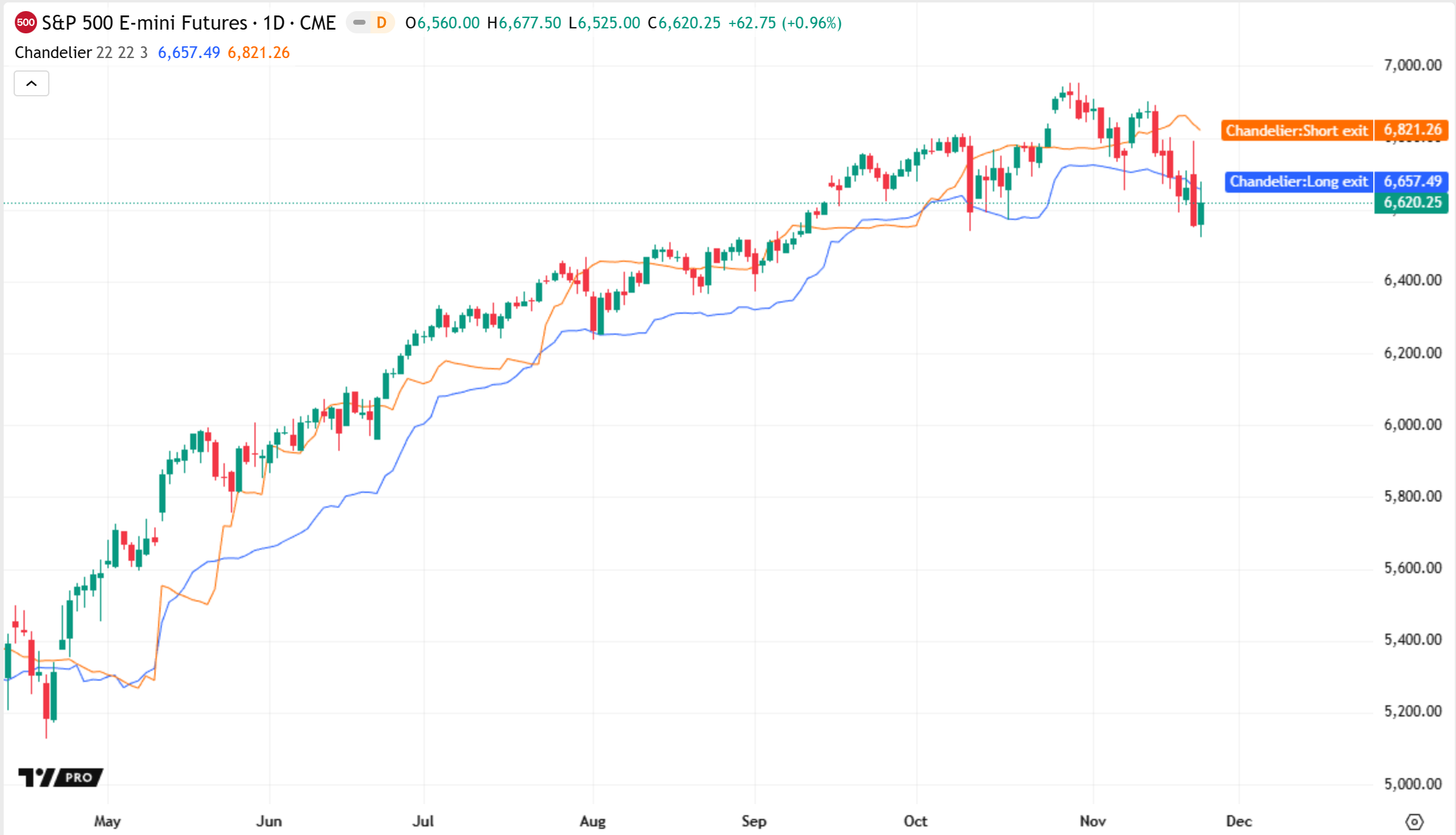
Cálculo
O indicador Saída de Chandelier calcula dois níveis de stop, um para operações de long e outro para operações de short, encontrando os preços mais altos e mais baixos em um determinado período de lookback e, em seguida, somando e subtraindo múltiplos do ATR. As fórmulas para calcular os níveis de saída são as seguintes:
Saída de Long = Preço Mais Alto − ATR × MultiplicadorSaída de Short = Preço Mais Baixo + ATR × MultiplicadorOnde:
- Preço Mais Alto e Preço Mais Baixo são os preços mais altos e mais baixos durante o período de lookback especificado
- ATR é o Average True Range com um determinado comprimento
- Multiplicador é um fator de escala que afeta a distância na qual os níveis de parada seguem atrás dos preços mais altos e mais baixos
Os níveis resultantes seguem atrás do preço de mercado por uma quantidade variável, expandindo ou contraindo a distância de trailing em resposta a mudanças na volatilidade, ou extremos de preços locais.
O valor de saída de compra (linha azul) aumenta quando ocorre qualquer uma das seguintes condições:
- O preço mais alto aumenta em uma quantidade maior do que o aumento no ATR
- O ATR diminui em uma quantidade maior do que a diminuição no preço mais alto
Da mesma forma, o valor de saída de venda (linha laranja) diminui quando ocorre qualquer uma destas condições:
- O preço mais baixo diminui em uma quantidade maior do que o aumento no ATR
- O ATR diminui em uma quantidade maior do que o aumento no preço mais baixo
O objetivo do indicador Saída de Chandelier é identificar potenciais pontos de saída com base em reversões de preços significativas após uma tendência estabelecida:
- O preço de mercado cruzando abaixo do nível de saída de compra pode sugerir o fim de uma tendência de alta, sinalizando um possível ponto de saída para uma posição de compra
- O preço cruzando acima do nível de saída de venda pode sugerir o fim de uma tendência de baixa, sinalizando um possível ponto de saída para uma posição de venda
Embora o propósito pretendido do indicador seja identificar pontos de saída, alguns traders também usam os níveis da Saída de Chandelier para ajudar a detectar tendências para criar ou filtrar sinais de negociação. O preço de mercado cruzando ou persistindo acima dos níveis pode sugerir a confirmação de uma forte tendência de alta, e vice-versa para uma tendência de baixa.
Input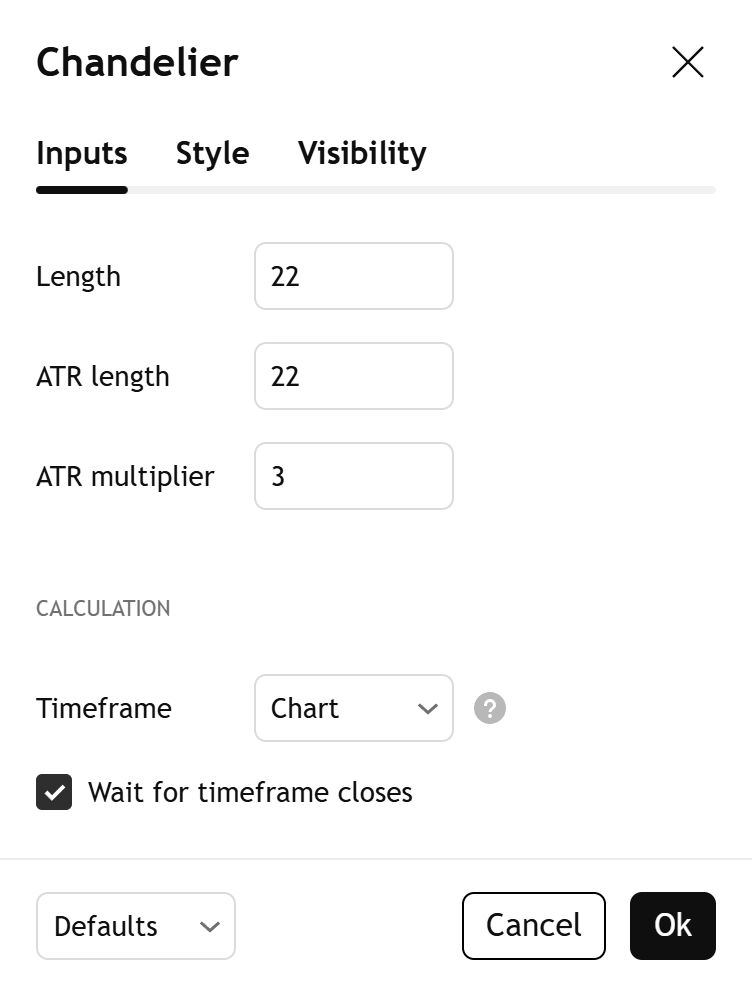
Comprimento
O número de barras para trás a serem pesquisadas para determinar a máxima mais alta para o nível de saída de compra e a mínima mais baixa para o nível de saída de venda.
Comprimento do ATR
O comprimento para o fator de suavização do Average True Range para ambos os níveis de saída. Um valor menor fornece mais responsividade a flutuações rápidas, enquanto um valor maior aumenta a suavização para volatilidade de longo prazo.
Multiplicador do ATR
O fator de escala do ATR para ambos os níveis de saída. Afeta a distância em que os níveis seguem atrás dos preços mais altos e mais baixos. Um valor menor faz com que os níveis sigam a máxima e a mínima mais de perto. Um valor maior aumenta a distância dos extremos de preço até os níveis de parada.
Tempo gráfico
Define o tempo gráfico que o indicador usa para seus cálculos. A caixa de seleção "Aguardar o fechamento do tempo gráfico" abaixo determina se o indicador mostra resultados apenas quando uma barra no tempo gráfico especificado fecha. Veja o artigo Aproveitando a análise de múltiplos tempos gráficos para saber mais.