Price Momentum Oscillator (PMO)
O Price Momentum Oscillator (PMO), criado por Carl Swenlin, é um indicador de momentum que mede a suavizada barra a barra taxa de variação (ROC) no preço de um instrumento. O indicador aplica dois estágios de suavização ao ROC e usa uma MME do resultado como uma linha de sinal.
O PMO funciona de forma semelhante a indicadores como o MACD. Os traders normalmente o utilizam para medir o momentum de curto prazo, identificar tendências em desenvolvimento ou oportunidades de reversão à média, e encontrar divergências ou outros padrões. No entanto, como o indicador suaviza o ROC de uma única barra em vez de calcular a diferença entre as médias de preços, ele é menos sensível à magnitude absoluta dos movimentos de preços, resultando frequentemente em uma escala mais consistente ao longo do histórico do gráfico.
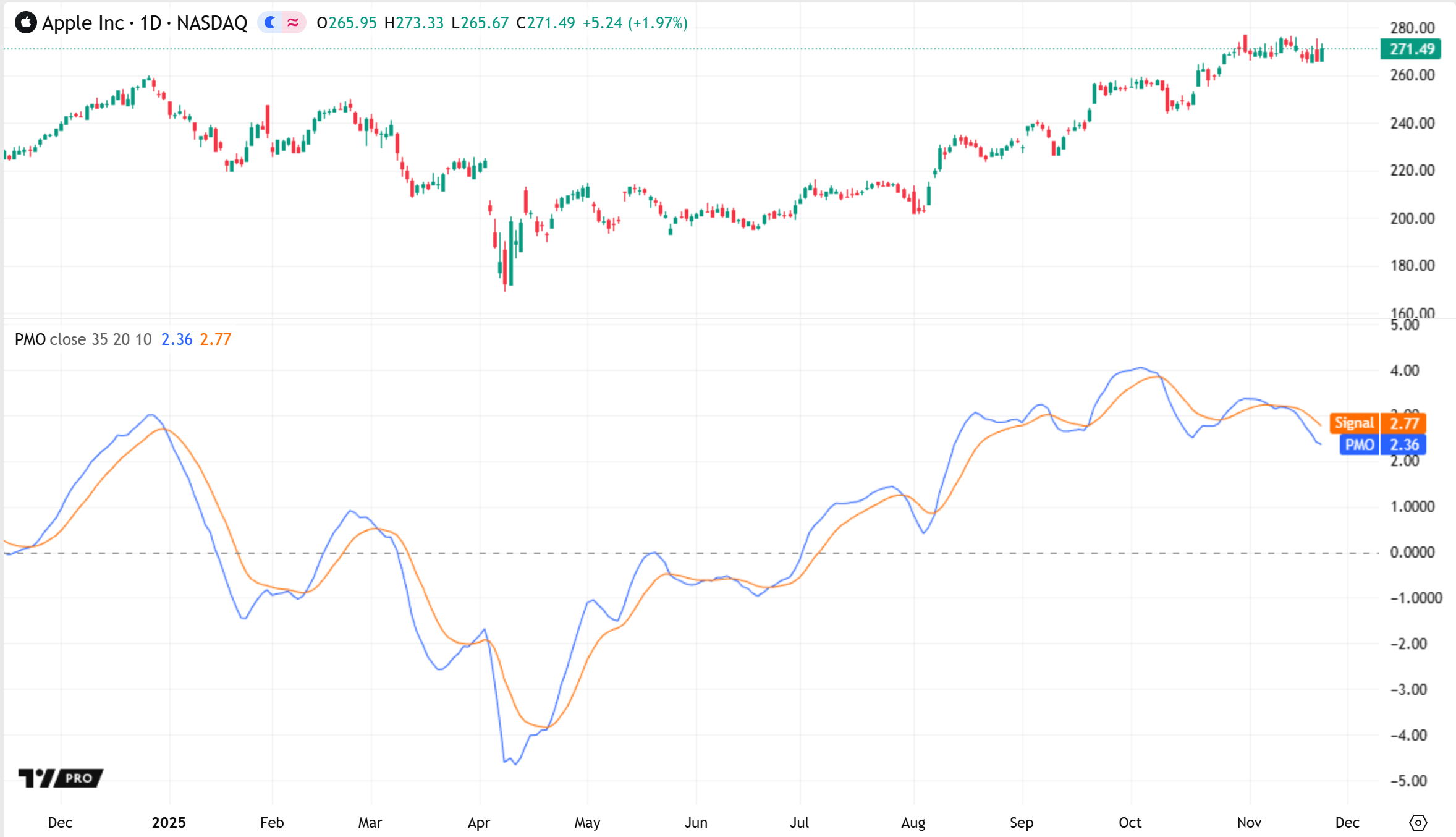
Cálculo
O indicador PMO aplica dois estágios de suavização exponencial personalizada, com comprimentos diferentes, ao ROC de uma barra dos preços de mercado. Em seguida, ele calcula uma linha de sinal usando uma EMA padrão. As etapas para calcular os valores do PMO e do sinal são as seguintes:
- Calcule a variação percentual nos preços, representando o ROC de uma barra.
- Aplique uma EMA com um fator de suavização personalizado à série ROC. Em vez do fator de suavização padrão de 2 / (comprimento + 1), esta EMA utiliza o fator 2 / comprimento.
- Multiplique a série suavizada por 10 e aplique uma segunda EMA usando a mesma fórmula de fator de suavização personalizado para calcular o PMO.
- Aplique uma EMA padrão ao PMO para calcular a linha de sinal.
O indicador plota o PMO suavizado e sua linha de sinal em um painel separado, junto com uma linha horizontal no zero para distinguir as leituras de momentum positivas e negativas. A interpretação usual deste indicador é semelhante à do indicador MACD:
- Valores de PMO acima de 0 indicam momentum médio ascendente. Valores abaixo de 0 indicam momentum médio descendente.
- Os cruzamentos entre o PMO e a linha de sinal indicam mudanças de momentum de curto prazo. O PMO cruzando acima da linha de sinal sugere que o momentum está mudando para cima ou continuando para cima. O PMO cruzando abaixo da linha de sinal sugere o oposto.
- Divergências nos movimentos relativos do PMO e do preço podem ajudar a identificar pontos de virada ou mudanças nas tendências. Por exemplo, picos descendentes no PMO enquanto o preço de mercado está subindo podem sugerir a exaustão de uma tendência de alta. Da mesma forma, fundos ascendentes no PMO enquanto o preço de mercado está caindo podem sugerir a exaustão de uma tendência de baixa.
Inputs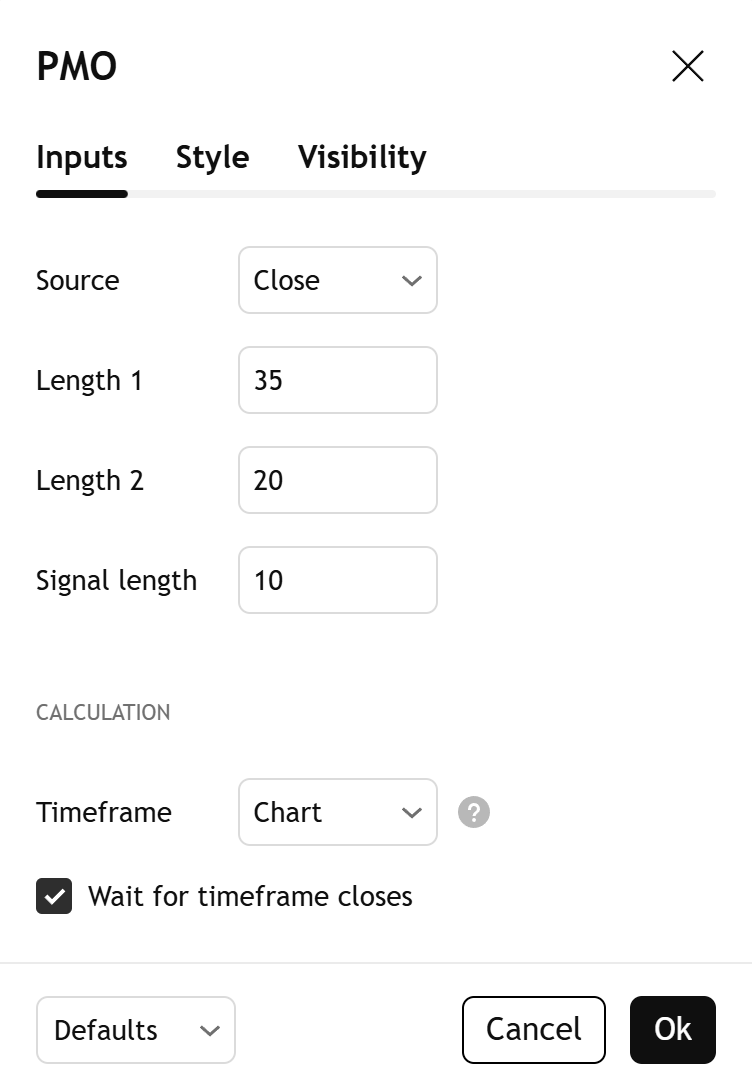
Fonte
A série de valores para os quais calcular o PMO.
Comprimento 1
O comprimento para o primeiro estágio de suavização exponencial.
Comprimento 2
O comprimento para o segundo estágio de suavização exponencial.
Comprimento do sinal
O comprimento para a EMA padrão do PMO (linha de sinal).
Tempo gráfico
Define o tempo gráfico que o indicador utiliza para seus cálculos. A caixa de seleção "Aguardar o fechamento do tempo gráfico" abaixo determina se o indicador mostra os resultados apenas quando uma barra no tempo gráfico especificado fecha. Veja o artigo Aproveitando a análise de múltiplos tempos gráficos para saber mais.