Planetary IngressDisplays planetary ingresses, the moments when a planet crosses from one zodiac sign into another. This indicator marks historical ingresses directly on your chart and projects upcoming ones with precise date, time, and retrograde status.
Powered by the open-source BlueprintResearch Planetary Ephemeris library , which implements truncated VSOP87 (planets) and ELP2000 (Moon) series for high-accuracy celestial calculations entirely within Pine Script.
█ FEATURES
• All 10 celestial bodies — Sun, Moon, Mercury, Venus, Mars, Jupiter, Saturn, Uranus, Neptune, and Pluto
• Geocentric or Heliocentric views — toggle between Earth-centered (standard astrology) and Sun-centered perspectives
• Retrograde indicator — shows ℞ symbol when a planet is in apparent retrograde motion (geocentric only)
• Future ingress projection — displays the following sign change as a dotted vertical line with customizable date/time and timezone
• Color-coded by zodiac sign — 12 fully customizable colors for each sign
• Per-sign visibility controls — easily show/hide specific signs
• Per-sign alerts — get notified when a planet enters selected signs
• Fully customizable labels — adjust size, colors, transparency, and placement
█ HOW TO USE
1. Select your planet from the dropdown
2. Choose Geocentric (traditional) or Heliocentric view
3. Historical ingresses appear as labels above price bars with a planet symbol and a zodiac sign
4. The next future ingress is shown as a dotted vertical line with projected date/time
5. Hover over labels for exact degree position (e.g., "0°Ari00'")
6. Set up alerts via "Alert on Ingress" settings for specific sign entries
█ LIMITATIONS & ACCURACY
This indicator uses optimized, truncated VSOP87 and ELP2000 series tailored for Pine Script performance. It delivers excellent accuracy for trading and analytical purposes, but is not intended for professional astronomical use.
Expected Ingress Timing Accuracy (Geocentric view):
• Sun, Moon, Mercury, Venus, Mars: Within hours to ±1 day
• Jupiter, Saturn: Within ±1–2 days
• Uranus, Neptune: Within ±3–7 days
• Pluto: Within ±1–2 weeks (simplified Meeus method, valid 1900–2100)
Heliocentric view: Inner and faster-moving planets match geocentric accuracy. Outer planets (especially Uranus/Neptune) may occasionally show larger variances (up to ±1 month in rare cases) due to their extremely slow motion amplifying minor truncation effects in the series.
Why outer planets vary more:
Slower planets take weeks or months to cross a single degree. Even minor positional discrepancies from truncated terms can shift ingress timing by days or weeks—most noticeable with the outermost bodies.
Recommendation: For mission-critical timing, always cross-reference with professional tools such as JPL Horizons , Swiss Ephemeris, or Astro.com.
█ ROADMAP
Accuracy improvements are an ongoing priority. The modular library design allows targeted upgrades to individual planets without breaking existing functionality.
Planned Enhancements:
• Higher-precision outer planet calculations (Uranus, Neptune)
• Improved heliocentric outer planet accuracy
• Enhanced Pluto method
• Additional series terms where beneficial
Updates will be released through the BlueprintResearch/lib_ephemeris library—follow for notifications.
█ OPEN SOURCE
This indicator is part of the fully open-source Planetary Ephemeris project. The core ephemeris library is public for study, modification, and reuse in your own scripts:
• BlueprintResearch/lib_ephemeris — Main planetary calculation engine
Licensed under MPL 2.0 — free to use and modify, with changes to the library shared back to the community.
Zodiac

MathConstantsSolarSystemLibrary "MathConstantsSolarSystem"
Properties and data for the celestial objects in the Solar System.
Solar System in 3D [Astro Tool w/ Zodiac]Hello Traders and Developers,
I am excited to announce my latest Open Source indicator. At the core, this is a demonstration of PineScript’s capabilities in Rendering 3D Animations, while at the same time being a practical tool for Financial Astrologists.
This 3D Engine dynamically renders all the major celestial bodies with their individual orbits, rotation speeds, polar inclinations and astrological aspects, all while maintaining accurate spatial relationships and perspective.
This is a Geocentric model of the solar system (viewed from the perspective of Earth), since that is what most Astrologists use. Thanks to the AstroLib Library created by @BarefootJoey, this model uses the real coordinates of cosmic bodies for every timestamp.
This script truly comes to life when using the “Bar Replay” mode in TradingView, as you can observe the relationships between planets and price action as time progresses, with the full animation capabilities as mentioned above.
In addition to what I have described, this indicator also displays the orbital trajectories for each cosmic body, and has labels for everything. I have also added the ability to hover on all the labels, and see a short description of what they imply in Astrology.
Optional Planetary Aspect Computation
This indicator supports all the Major Planetary Aspects, with an accuracy defined by the user (1° by default).
Conjunction: 0° Alignment. This draws a RED line starting from the center, and going through both planets.
Sextile: 60° Alignment. This draws three YELLOW lines, connecting the planets to each other and to the center.
Square: 90° Alignment. This draws three BLUE lines, connecting the planets to each other and to the center.
Trine: 120° Alignment. This draws three PURPLE lines, connecting the planets to each other and to the center.
Opposition: 180° Alignment. This draws a GREEN line starting from one planet, passing through the center and ending on the second planet.
The below image depicts a Top-Down view of the system, with the Moon in Opposition to Venus and with Mars in Square with Neptune .
Retrograde Computation
This indicator also displays when a planet enters Retrograde (Apparent Backward Motion) by making its orbital trajectory dashed and the planet name getting a red background.
The image below displays an example of Jupiter, Saturn, Neptune and Pluto in Retrograde Motion, from the camera perspective of a 65 degree inclination.
Optional Zodiac Computation (Tropical and Sidereal)
Zodiac represents the relatively stationary star formations that rest along the ecliptic plane, with planets transitioning from one to the next, each with a 30° separation (making 12 in total). I have implemented the option to switch between Tropical mode (where these stars were 2,000 years ago) and Sidereal (where these stars are today).
The image below displays the Zodiac labels with clear lines denoting where each planet falls into.
While this indicator is deployed in a separate pane, it is trivial to transfer it onto your price chart, just by clicking and dragging the graphics. After that, you can adjust the visuals by dragging the scale on the side, or optimizing model settings. You can also drag the model above or below the price, as shown in the following image:
Of course, there are a lot of options to customize this planetary model to your tastes and analytical needs. Aside from visual changes for the labels, colors or resolution you can also disable certain planets that don’t meet your needs as shown below:
Once can also infer the current lunar phases using the Aspects between the Sun and Moon. When the Moon is Opposite the Sun that is a Full Moon, while when they are Conjunct that is a New Moon (and sometimes Eclipse).
—---------------------------------------------------------------------------
I have made this indicator open source to help PineScript programmers understand how to approach 3D graphics rendering, enabling them to develop ever more capable scripts and continuously push the boundaries of what's possible on TradingView.
The code is well documented with comments and has a clear naming convention for functions and variables, to aid developers understand how everything operates.
For financial astrologists, this indicator offers a new way to visualize and correlate planetary movements, adding depth and ease to astrological market analysis.
Regards,
Hawk


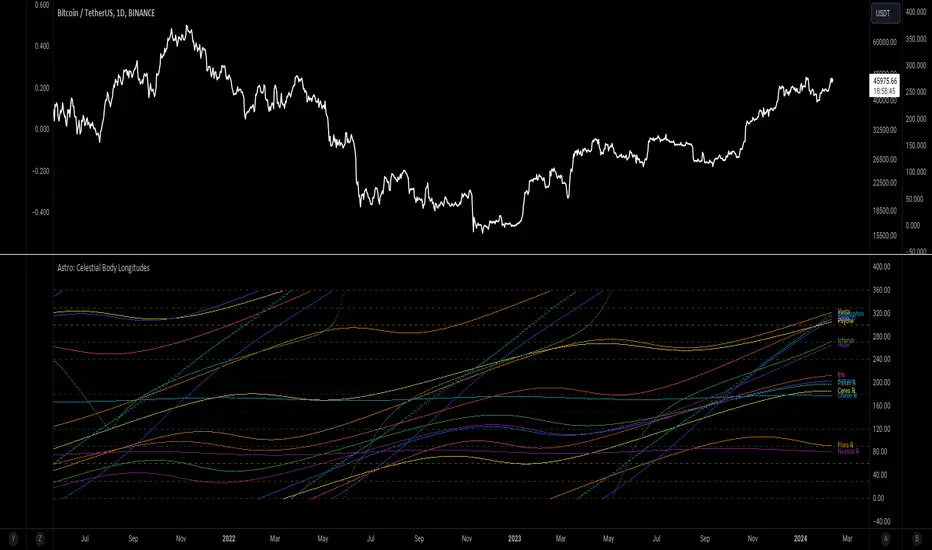
Astro: Celestial Body LongitudesThis is fork of the previous Astro: Planetary Longitudes indicator that now includes over a dozen different celestial bodies, made possible after the most recent update of the AstroLib library .
Celestial longitude is a measurement of the position of a celestial body in its orbit around the Sun, expressed in degrees of arc along the plane of the body's orbit. It is one of the fundamental coordinates used in astronomy to describe the position of a planet or other celestial object.
The concept of longitude is important in astrology, where it is used to determine the position of the planets in the zodiac. In this context, the longitude is measured along the ecliptic, which is the apparent path of the Sun on the celestial sphere. Astrologers use the position of the planets in the zodiac to make predictions and interpretations about personality traits, life events, earthquakes, market events, and other aspects of human experience.
This indicator includes geocentric/heliocentric longitude lines with retrograde identification, Vedic Nakshatras, and astrological zodiac & aspects for each of the celestial bodies. Hover over labels for additional information.
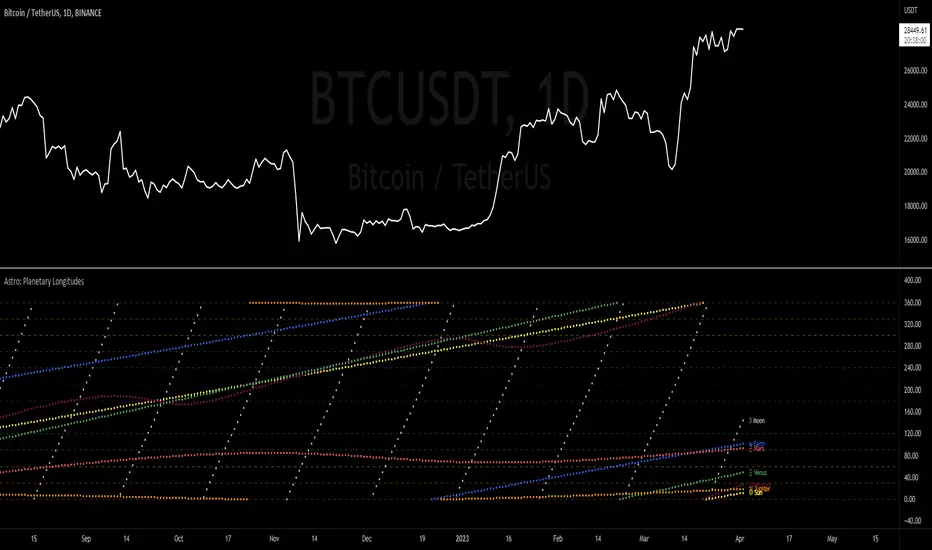
Astro: Planetary LongitudesPlanetary longitude is a measurement of the position of a planet in its orbit around the Sun, expressed in degrees of arc along the plane of the planet's orbit. It is one of the fundamental coordinates used in astronomy to describe the position of a planet or other celestial object.
The concept of planetary longitude is important in astrology, where it is used to determine the position of the planets in the zodiac. In this context, the longitude is measured along the ecliptic, which is the apparent path of the Sun on the celestial sphere. Astrologers use the position of the planets in the zodiac to make predictions and interpretations about personality traits, life events, earthquakes, market events, and other aspects of human experience.
This indicator includes geocentric/heliocentric longitude lines with retrograde identification, Vedic Nakshatras, and astrological zodiac & aspects for each of the 9 planets plus the Sun & Moon. Hover over labels for additional information.
🏅Shoutout to @AdzAdama and @Virinchi for all the help with this indicator