AMT Institutional Model v2What This Indicator Does
This indicator implements Fabio Valentini's Auction Market Theory (AMT) model — the same framework used by a verified World Cup Trading Championship competitor who achieved 218% audited returns in a single competition year.
The core principle is simple: The market is an auction. It moves between two states — Balance (choppy, no edge) and Imbalance (trending, tradeable). Most traders lose because they trade inside balance. This indicator tells you when to sit out and when conditions are aligned for entry.
It is a MODEL, not a strategy. It does not give buy/sell signals. It gives you the 3 conditions Valentini requires before any trade, and visually shows you when all 3 align.
The 3 Conditions (ALL Must Be True Before Entry)
Valentini's rule: "If even one is missing, you stay flat."
#ConditionWhat the indicator shows1Market State — Is the market OUT of balance?Background color: Yellow = Balance (DO NOT TRADE). Blue/Red = Imbalance (OK to look)2Location — Is price at a meaningful level?LVN lines (magenta), Support/Resistance (green/red dashes), HVN (yellow), POC (orange)3Aggression — Are large participants executing?Blue circles below bar = Buyer aggression. Red circles above bar = Seller aggression
When all 3 align, a green diamond (bull) or red diamond (bear) appears. This is the confluence signal — the premium setup.
How To Read The Chart — Step by Step
STEP 1 — Check the Balance Box (yellow dashed rectangle)
This is the Value Area where 70% of volume was traded. Think of it as a "no-fly zone."
Price INSIDE the box → Info table says "Inside VA - Skip" → Do nothing
Price OUTSIDE the box → Now you can start looking for setups
Valentini: "Market is usually in balance. That is why traders take a streak of stop-losses." The Balance Box keeps you out of the chop.
STEP 2 — Check the Background Color
🟡 Yellow tint = Balance. Market is compressed. Stay flat.
🔵 Blue tint = Imbalance Bullish. Trend is up. Look for longs only.
🔴 Red tint = Imbalance Bearish. Trend is down. Look for shorts only.
You need BOTH: price outside the Balance Box AND background showing Imbalance.
STEP 3 — Find Your Level
Look for price approaching one of these levels:
LVN (magenta dashed) — Low Volume Nodes. Price rejected here before and will likely react again. These are Valentini's primary entry zones. When price revisits an LVN, it either rips through (continuation) or bounces (reversal). Wait for aggression to confirm which one.
HVN (yellow solid) — High Volume Nodes. Price accepted here = consolidation zones. Good for targets, not entries.
POC (orange thick) — Point of Control. Highest volume price = "fair value." Strong magnet. Good for mean-reversion targets.
30m S/R (green/red dashed) — Auction pivot structure from the 30-minute timeframe.
Weekly/Daily/4H levels — Institutional reference levels. Confluence of multiple levels = stronger zone.
Fibonacci levels — Labeled with source timeframe (D = Daily, W = Weekly) so you always know where the level comes from.
STEP 4 — Wait for Aggression
Do NOT enter just because price is at a level. Wait for the circles (bubbles):
🔵 Blue circle below bar = Buyer aggression (volume spike + bullish close)
🔴 Red circle above bar = Seller aggression (volume spike + bearish close)
Circle size = intensity (small → normal → large = 2x → 3.5x → 5x+ volume)
Valentini: "When there is direction, location, and aggression — your ability to READ is 100%."
Entry Checklist (Long Example)
✅ Background is blue (Imbalance Bullish)
✅ Price is outside the Balance Box (above VAH or pulled back below VAL)
✅ Price is at or near an LVN, Support level, or Fibonacci level
✅ A blue circle appears below the bar (buyer aggression confirmed)
✅ 30-min trend line is blue (uptrend structure)
Enter long. Stop below the LVN / support level.
For shorts, mirror everything: red background, near resistance/LVN, red circle above bar, red trend line.
Exit Rules
Exit TypeWhenPrimary targetThe POC (orange line). Valentini: "Target the previous balance POC — 70% of the time, price reverses from it."Secondary targetThe next HVN (yellow line). Price tends to slow down and consolidate at HVNs. Take partial profits here.Structural targetThe next major Weekly/Daily level or Fibonacci level in the direction of your trade.Failed auction exitIf you're long and an X cross appears above your bar — this means aggressive buyers failed. The sellers won. Close immediately.Re-entry of Balance BoxIf price re-enters the Value Area after breaking out, the breakout may have failed. Tighten stop or exit. This is Valentini's Mean Reversion Model — the snap-back.Opposite aggressionLarge red circles appearing in your long trade = institutional selling. Reduce size or exit.
What Each Module Does
Module A — 30-Min Trend (blue/red step-line)
Auction-based trend structure from 30-minute Higher-Highs/Higher-Lows. Not a moving average — this is structural.
Module B — 30-Min S/R (green/red dashed)
Pivot-based support and resistance from 30-minute auction structure. Sensitivity setting controls how many levels appear.
Module C — Aggression Bubbles (circles + X crosses)
Volume spike detection with directional body filter. 3 size tiers. X crosses mark failed auctions — when aggression fails and price reverses.
Module D — MTF Levels (colored horizontal lines)
Weekly, Daily, 4H, Hourly OHLC levels + Daily/Weekly Fibonacci retracements (labeled with source TF) + 20/50 SMA + Psychological round numbers. All line colors and widths fully customizable.
Module E — Balance/Imbalance (background color)
ATR compression ratio detects whether market is ranging or trending. Yellow = stay out. Blue/Red = conditions forming.
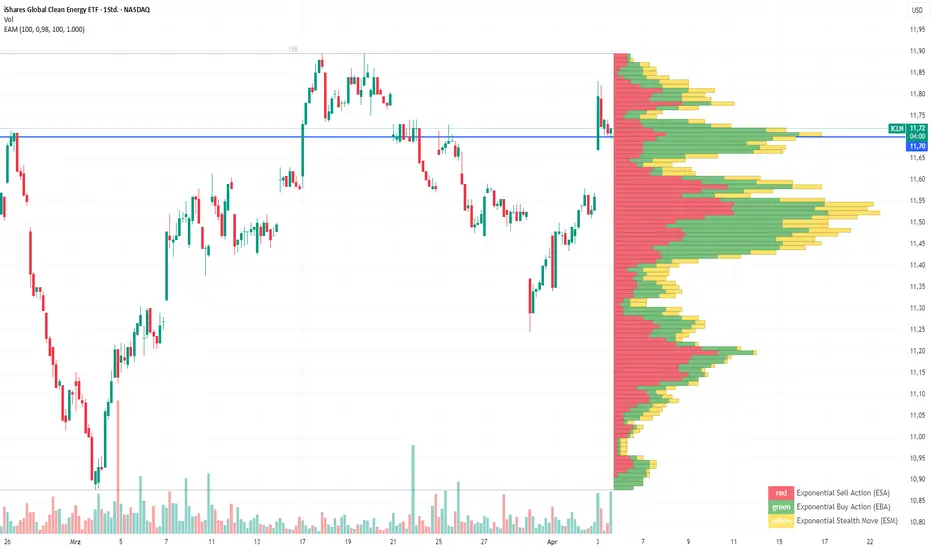
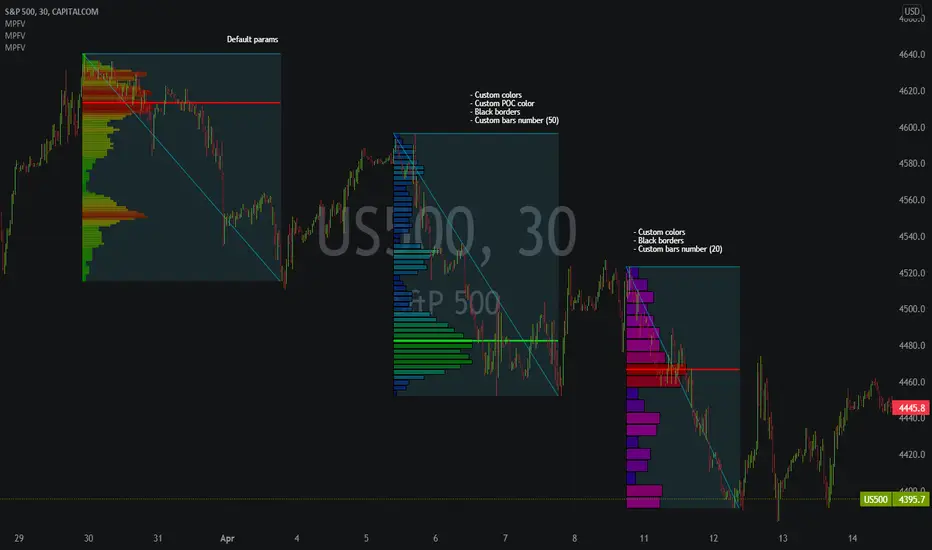
Module F — Volume Profile (HVN/LVN/POC/Balance Box)
Bin-based volume distribution over configurable lookback. Same methodology as ATAS, Sierra Chart, and TradingView's own SVP. Draws the Value Area box (skip trades inside), POC, and all significant volume nodes.
Settings Guide
Sensitivity — The single most important setting.
Low = Strict. Fewer levels, fewer bubbles, only the strongest signals. For experienced traders who want a clean chart.
Medium = Balanced. Recommended default.
High = Sensitive. More signals, catches weaker setups. Good for learning or scalping.
Futures vs ETF — Futures (NQ/ES/YM) have concentrated RTH volume so lower multipliers work. ETFs (SPY/QQQ) need higher thresholds to filter dark-pool noise.
Label Mode — "Detailed" for learning, "Short" for clean charts once you know the levels.
Label Size — Auto/Tiny/Small/Normal/Large. All labels respect this setting.
Important Limitations
⚠️ No true order flow. TradingView does not provide tick-by-tick data, DOM, or executed vs. limit order differentiation. Aggression bubbles are a volume-spike proxy, not true order flow. For real order flow, use platforms like Bookmap, ATAS, or Sierra Chart alongside this indicator.
⚠️ Volume profile is approximated. Each bar's volume is proportionally distributed across its price range. Real volume-at-price requires tick data. This is the standard approximation used by all Pine Script volume profile implementations.
⚠️ This is a model, not a strategy. It shows conditions. You make the decision. No indicator replaces screen time and discretion.
Alerts Available (12 total, all configurable ON/OFF)
Bull Confluence | Bear Confluence | Failed Buy Auction | Failed Sell Auction | Huge Buy Volume (5x+) | Huge Sell Volume (5x+) | Balance/Imbalance Shift | 30-Min Trend Change | Any Aggression | Price at Key Level | Price Exits Value Area | Price at POC
Built for NQ/ES futures day trading. Works on any liquid instrument with volume data. Not financial advice.
Indicador Pine Script®