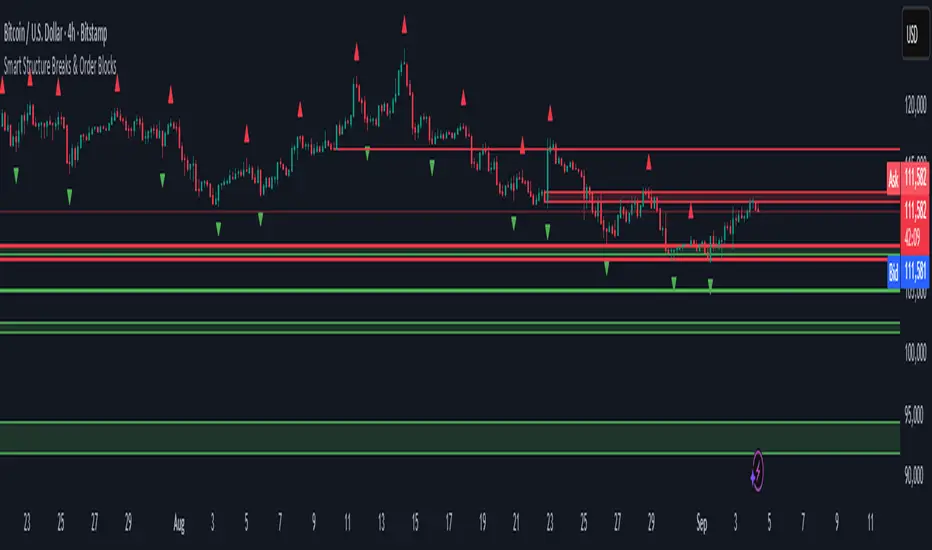
Fractal Structure Model [Pro]Fractal Structure Model
A professional-grade multi-timeframe price action indicator that automates the identification of expansion setups by analyzing lower timeframe movements within higher timeframe candle structures.
<h
🔷 What This Indicator Does
Markets move in fractal cycles — alternating between contraction (consolidation) and expansion (directional movement). This indicator detects the precise moment when expansion is likely to begin by combining:
Higher Timeframe directional candle closures
Lower Timeframe confirmation through Change in State of Delivery (CISD)
Automated projection of future price targets
Real-time setup tracking with success/failure detection
⚙️ Core Components
1. Automatic Timeframe Pairing
The indicator intelligently pairs your chart timeframe with a higher timeframe for multi-timeframe analysis:
1min → 5min
3min → 15min
5min → 1Hour
15min → 4Hour
1Hour → Daily
4Hour → Weekly
Manual override is available for custom pairings. The indicator validates pairings and displays warnings for invalid configurations.
2. HTF Power of Three (PO3) Candles
Visualizes the higher timeframe candle directly on your lower timeframe chart:
Translucent body box (open to close range)
Wick lines extending to high and low
Dashed open price reference line
Timeframe badge label
This allows you to observe how micro price action constructs the macro candle — identifying accumulation, manipulation, and distribution phases in real time.
3. Change in State of Delivery (CISD)
The CISD is the confirmation signal that price has shifted from one directional bias to another.
Bullish CISD Logic:
text
- Price was making lows (testing swing low area)
- A candle closes above its open AND above the previous candle's high
- This signals sellers have exhausted and buyers are taking control
Bearish CISD Logic:
text
- Price was making highs (testing swing high area)
- A candle closes below its open AND below the previous candle's low
- This signals buyers have exhausted and sellers are taking control
Visual: A highlighted box around the CISD candles with a directional label.
Use Case: After the 1-Hour candle closes bullish, you watch the 5-minute chart for a bullish CISD near a swing low. When it triggers, it confirms that the new hour is likely to continue expanding upward.
4. Setup Detection
A complete setup requires two conditions:
Condition Description
HTF Directional Close The previous HTF candle closed bullish or bearish
LTF CISD Confirmation A change in delivery state occurs on the lower timeframe
When both align, the indicator generates a setup signal with a bold vertical bar and a large directional label.
Use Case: The previous 4-Hour candle closed strongly bearish. On your 15-minute chart, you see price briefly push up into a swing high, then a bearish CISD fires. The indicator marks this as a Bear Setup, telling you expansion to the downside is probable.
5. Candle Tracking (C1 through C4+)
Once a setup triggers, the indicator tracks how many HTF candles have elapsed:
Label Meaning Color
C1 ✓ First candle — setup just formed Gray
C2 ✓ Second candle — setup active and healthy Gray
C3 ⚠ Third candle — potential slowdown/consolidation Orange
C4 ⚠ Fourth candle — likely exhaustion Orange
Any ✗ Price returned to setup origin — failure Red
Failure Condition:
Bullish setup fails if price drops below the setup low
Bearish setup fails if price rises above the setup high
Use Case: You entered a bullish trade on C1. By C2, price has expanded nicely. On C3, the label turns orange — you consider tightening your stop or taking partial profits because momentum may be fading. If it turns red, you know the setup has been invalidated.
6. Equilibrium + Premium/Discount Zones
The Equilibrium (EQ) is the 50% level of the setup range (from setup high to setup low).
Zone Location Meaning
Premium Above EQ Price is expensive — favorable for shorts
Discount Below EQ Price is cheap — favorable for longs
Visual: Two shaded boxes with text labels ("PREMIUM" / "DISCOUNT") and a dashed EQ line.
Use Case: After a bullish setup fires, price retraces. You see it enter the discount zone (below 50%). This is your optimal entry area — buying at a discount within a confirmed bullish structure.
7. T-Spot Identification
The T-Spot marks where the higher timeframe candle's wick is anticipated to form — essentially a reversal or continuation point.
Calculation: 23.6% from the setup extreme (based on Fibonacci-like proportioning of the range).
Visual: A dotted line with a thin zone box and "T-SPOT" label.
Use Case: In a bullish setup, the T-Spot sits near the top of the range. If price reaches this level and shows signs of rejection, it may indicate the HTF candle's high wick is forming — a potential point to take profits or expect a pullback.
8. Projection Levels
Once a setup is confirmed, the indicator projects future price targets based on the range between the CISD price and the swing reference point.
Default Projections:
Level Calculation Purpose
-1× 1× the CISD range First target — minimal expansion
-2× 2× the CISD range Standard expansion target
-2.5× 2.5× the CISD range Extended target
-4× 4× the CISD range Full expansion
-4.5× 4.5× the CISD range Maximum expected expansion
Each projection has:
A solid line at the level
A thin zone box for visibility
A multiplier label (e.g., "-2×")
Progressive transparency (closer targets are more opaque)
Use Case: A bearish setup fires. You set your take-profit at the -2× projection. If price reaches -2× and shows exhaustion, you exit. If momentum continues, you trail toward -4×.
9. Formation Liquidity
Marks the previous HTF candle's high and low as critical liquidity levels.
Visual: Dotted horizontal lines labeled "LIQ $.H" (high) and "LIQ $.L" (low).
Use Case: Before a new setup forms, price often sweeps the previous candle's high or low to grab liquidity. Watching these levels helps you anticipate:
Where stop losses are clustered
Where engineered liquidity raids may occur
Potential reversal points after the sweep
10. Candle 1 Liquidity
Solid horizontal lines marking the setup's own high and low — the structural boundaries.
Use Case: These are your invalidation levels. If a bullish setup's low is broken, the setup fails. These lines give you a clear visual reference for stop-loss placement.
11. Swing Structure Markers
Small diamond symbols (◆) at detected swing highs and lows.
Use Case: Helps you see the market's structural rhythm — where swing points form relative to the HTF candle. Useful for identifying when price is building higher lows (bullish) or lower highs (bearish).
12. Bias Selection
Mode What It Shows
Bullish Only bullish CISD signals and setups
Bearish Only bearish CISD signals and setups
Neutral Both directions
Use Case: You've done your daily analysis and determined the market is in a bullish trend. You set bias to "Bullish" to filter out counter-trend bearish signals and focus exclusively on buy setups.
13. Time Filters
Three configurable UTC time windows. Setups outside these windows are ignored.
Example Configuration:
Session 1: 08:00 - 11:00 (London Open)
Session 2: 13:00 - 16:00 (New York Open)
Session 3: OFF
Use Case: You only want to trade during London and New York sessions because that's when the most volume and expansion occurs. The indicator automatically suppresses signals during Asia session or off-hours.
14. Professional Info Table
A dark-themed dashboard showing:
Field Example Value
Pairing 5 → 60
Status ✓ Valid
Bias ▲ Bullish
Setup ▲ Bull C2
Auto TF ● Enabled
Sessions 8:00-11:00 13:00-16:00
Total 12 setups
15. Alerts
Alert Trigger
Bullish Fractal Setup Full bullish setup confirmed
Bearish Fractal Setup Full bearish setup confirmed
Bullish CISD Bullish delivery change detected
Bearish CISD Bearish delivery change detected
Setup Failed Active setup invalidated
Trading Workflow — Complete Use Case
Scenario: Trading EUR/USD on the 5-Minute Chart
Step 1 — Preparation
- Open 5min chart
- Indicator auto-pairs to 1H HTF
- Set bias to "Neutral"
- Enable London + NY time filters
Step 2 — Wait for HTF Context
- Watch the PO3 candle building the current hour
- Previous 1H candle closed bullish
- Current hour opens → you watch for a pullback
Step 3 — CISD Confirmation
- Price pulls back to a 5min swing low
- A 5min candle closes above its open and above the prior high
- CISD marker appears → Bullish Setup triggers
- Labels, projections, EQ zones all appear automatically
Step 4 — Entry
- Price is in the DISCOUNT zone (below EQ)
- Enter long near the CISD level
- Stop loss below the C1 Liquidity low line
Step 5 — Management
- C1 label shows ✓ — setup is fresh
- Price reaches -1× projection → move stop to breakeven
- C2 label appears ✓ — momentum continues
- Price hits -2× projection → take 50% profit
- C3 label turns orange ⚠ — trail stop tightly
- Price reaches -2.5× → close remaining position
Step 6 — Failure Scenario
- If price drops below setup low before hitting targets
- C2 label turns red ✗
- Projections, EQ, T-Spot all disappear
- You exit the trade at your stop loss
Who Is This Indicator For?
Trader Type How They Use It
Day Traders 1min/5min charts paired with 15min/1H for intraday setups
Swing Traders 15min/1H charts paired with 4H/Daily for multi-day holds
Scalpers 1min charts paired with 5min for quick expansion trades
Analysts Use projections and structure labels for market commentary
Key Strengths
Non-repainting — levels remain stable once plotted
Fully automated — no manual drawing required
Multi-asset — works on forex, crypto, stocks, indices, commodities
Adaptive — auto-adjusts to any timeframe
Professional visuals — clean, institutional-grade appearance with black text on colored labels for maximum readability
Indicador Pine Script®