OPEN-SOURCE SCRIPT
Atualizado Guassian Distribution Forecast [prediction intervals]
The Indicator
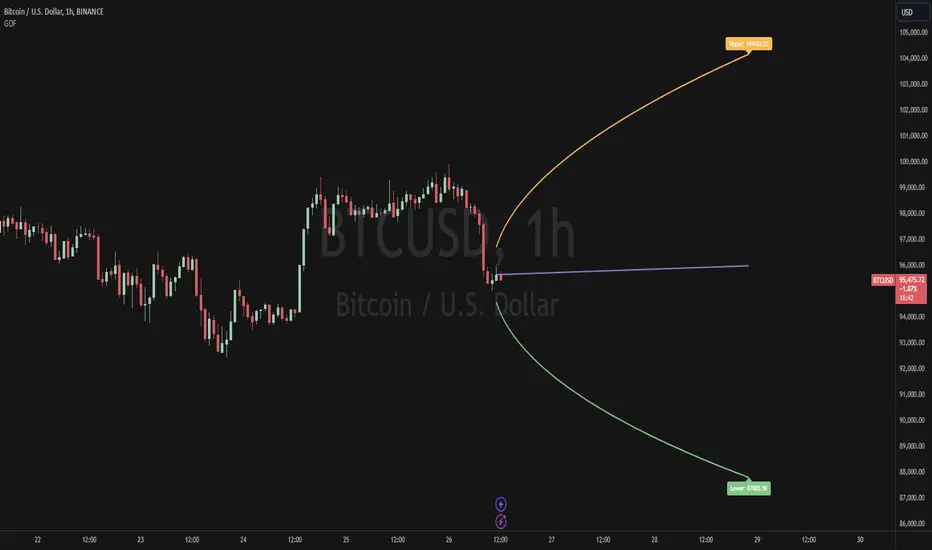
The Indicator combines volatility and frequency distributions to forecast an area of possible price expansion with an approximate confidence interval / level and level of significance (significance level).
The Script Formula

Additional comments
To alter the models forecasting precision to reflect a given confidence interval, e.g the 90% confidence level (C.L.), use the 1.64 multiplier (toggle value in "Standard normal distribution sd" setting), to use a specific C.L., e.g. the 85th percentile either search for this on google, or calculate it yourself using a Standard Normal Distribution Probability table. Additionaly volatility may be changed by toggling the lookback period setting, this can be thought of as widening the distribution tails.
The look forward parameter is currently fixed at 20, this is because it does not currently work correctly with higher integers, I will try resolve this problem and any other bugs as soon as possible
The Indicator combines volatility and frequency distributions to forecast an area of possible price expansion with an approximate confidence interval / level and level of significance (significance level).
The Script Formula
Additional comments
To alter the models forecasting precision to reflect a given confidence interval, e.g the 90% confidence level (C.L.), use the 1.64 multiplier (toggle value in "Standard normal distribution sd" setting), to use a specific C.L., e.g. the 85th percentile either search for this on google, or calculate it yourself using a Standard Normal Distribution Probability table. Additionaly volatility may be changed by toggling the lookback period setting, this can be thought of as widening the distribution tails.
The look forward parameter is currently fixed at 20, this is because it does not currently work correctly with higher integers, I will try resolve this problem and any other bugs as soon as possible
Notas de Lançamento
- Fixed forecast limit to chart maximum = 100 bars of x unit time in future. Script now uses polyline
chart.point
- Price labels for chart maximum and chart minimum forecasts
- Different Forecasting types (Price, Normal, Log-Normal (this is the exponential of the normal distribution)
Model Assumptions:
For “Price”
- Normal distribution of residuals (difference between source and moving average at time i where moving average is constant)
- Independence of residuals (i.e. we assume residuals are iid)
- Stationarity of time series (we assume that the mean = moving average and variance is remains constant over the forecast horizon)
For “Normal” and “Log-Normal” forecasting type
- Log-Normal distribution of residuals (difference between log returns and mean sample log returns at time i where sample mean is constant over lookback period)
- Independence of residuals (i.e. we assume residuals are iid)
- Stationarity of drift (mu) and log returns (sigma)
Comments on the Log-Normal Forecast Model
Simulating asset-prices assuming a log-normal distribution is preferred as it models real life scenarios most accurately, e.g. it caters to the fact of non-negative prices, positive skewness and multiplicativity, assumptions that the other models fail to make.
If we were to simulate asset prices via GBM (geometric brownian motion) using the same mean and variance parameters as in our residual standard deviation and simulate n paths, we would expect the price to remain within the confidence interval (by assumption) approximately C.I amount of the time where C.I. is the confidence level corresponding to the Z score used in the residual standard deviation of log returns(e.g. a 90% C.I. means 90% of all sampled values will be less than or as extreme as the corresponding Z score value, in this case 1.64). In other words only (1 - C.I.)% of the time would we expect a more extreme prediction. This is because GBM assumes normally distributed log returns, constant drift and volatility.
Let's take the following example, we have a 95% C.I., so we expect only 5% of simulated GBM paths to lie outside our confidence interval. We can see this in action below. note by law of large numbers, the limit as n (number of simulated paths) tends to infinity of the probability that the number of values that lie within the confidence interval will tend towards its theoretical maximum identical to our C.I.
Script de código aberto
Em verdadeiro espírito do TradingView, o criador deste script o tornou de código aberto, para que os traders possam revisar e verificar sua funcionalidade. Parabéns ao autor! Embora você possa usá-lo gratuitamente, lembre-se de que a republicação do código está sujeita às nossas Regras da Casa.

Aviso legal
As informações e publicações não se destinam a ser, e não constituem, conselhos ou recomendações financeiras, de investimento, comerciais ou de outro tipo fornecidos ou endossados pela TradingView. Leia mais nos Termos de Uso.
Script de código aberto
Em verdadeiro espírito do TradingView, o criador deste script o tornou de código aberto, para que os traders possam revisar e verificar sua funcionalidade. Parabéns ao autor! Embora você possa usá-lo gratuitamente, lembre-se de que a republicação do código está sujeita às nossas Regras da Casa.
Aviso legal
As informações e publicações não se destinam a ser, e não constituem, conselhos ou recomendações financeiras, de investimento, comerciais ou de outro tipo fornecidos ou endossados pela TradingView. Leia mais nos Termos de Uso.